Key Takeaways
- Forex and spot gold have no single official price. Each broker streams its own quotes, built from the banks and liquidity providers it connects to.
- Small gaps are normal, but some patterns are warning signs. Gaps that come and go are routine, while spikes only your broker shows or slippage that always goes against you deserve questions.
- Charts can differ even when prices match. Server time zones, Bid based candles and symbol settings change daily candles, highs, lows and indicator values.
- A bot trades the prices its own broker shows. Test a bot built with XAUBOT on a demo account at the same broker you plan to use live.
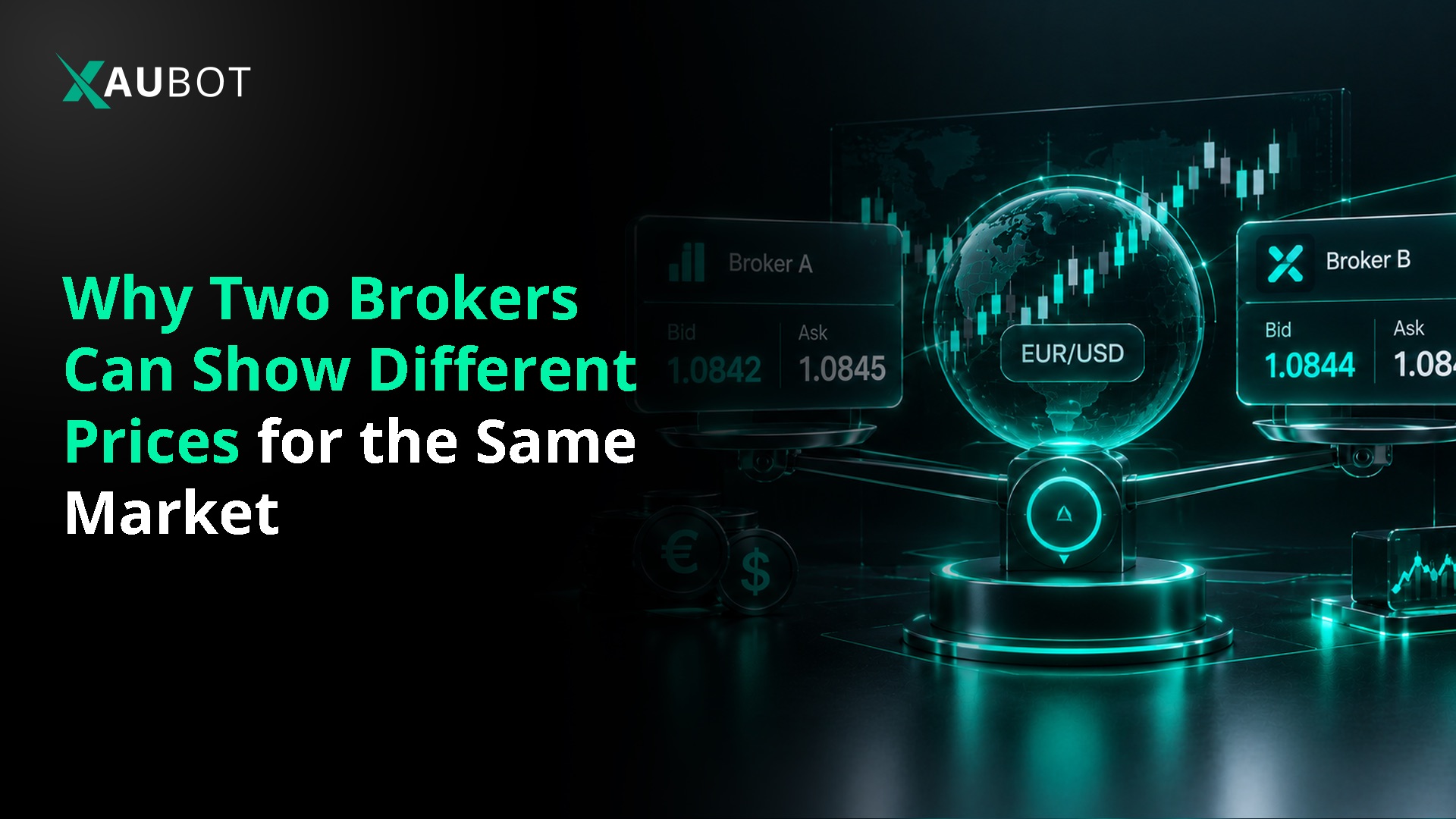
Two brokers can show different prices for the same market because forex, spot gold and most CFDs have no single official price. Each broker builds its quotes from its own liquidity providers, adds its own spread, and streams them through its own servers, which is where most broker price differences come from. At the same moment, one broker might quote EUR/USD at 1.16010 and another at 1.16016.

Most of the time these gaps are tiny and harmless. They still explain why a stop loss can trigger at one broker and not another, why candles look different, and why the same trading bot can produce different results.
This guide explains where the differences come from, how to tell normal gaps from warning signs, and what they mean if you trade with an Expert Advisor.
Why Forex Has No Single Price
A share of Apple has one main venue where trades are recorded. Forex works differently, because it trades over the counter between banks, dealers and brokers rather than on one central exchange.
The MetaTrader 5 help on price data describes this well. Big banks and prime brokers trade with each other in networks, and each participant either combines its counterparties’ prices or sets its own prices based on them before passing them to clients.
The market is also enormous and spread out. The Bank for International Settlements’ 2025 survey measured about $9.6 trillion of currency trading a day, with dealers in the UK, the US, Singapore and Hong Kong handling 75% of it. With that many dealers quoting at once, no single number can be “the” price.
Spot gold works the same way, trading mostly over the counter. Index CFDs add another layer, because each broker chooses what to base its price on.
Six Causes of Broker Price Differences
| Cause | What happens | What you notice |
|---|---|---|
| Liquidity providers | Each broker connects to a different group of banks and market makers | Small gaps in bid and ask |
| Spread and markup | Brokers widen the raw spread by different amounts | Same middle price, different bid and ask |
| Feed speed and filtering | Quotes arrive at different speeds, and some brokers filter outlier ticks | Spikes at one broker only |
| Underlying product | Index and metal CFDs can track the cash market or futures | Prices that sit consistently apart |
| Server time zone | Brokers start their trading day at different hours | Different daily candles |
| Symbol settings | Digits, contract size and symbol names vary | Different pip values and indicator readings |
Different liquidity providers
Most retail brokers receive prices from several banks and non bank market makers at once. Their system picks the best bid and the best ask from that group and shows them to you.
Two brokers rarely use the same group, and even shared providers may quote each broker slightly differently. So the best available bid and ask differ, usually by a fraction of a pip on major pairs.
Spread and markup
This is often the biggest visible cause. A raw spread account usually shows prices close to what the broker receives and charges a commission, while a standard account builds the broker’s fee into a wider spread.
| Example EUR/USD quote | Broker A (raw account) | Broker B (standard account) |
|---|---|---|
| Bid | 1.16010 | 1.16004 |
| Ask | 1.16012 | 1.16018 |
| Spread | 0.2 pips | 1.4 pips |
| Middle price | 1.16011 | 1.16011 |
| Cost per round trip on 1 lot | $2 spread plus an example $7 commission, so $9 | $14 spread, no commission |
Both brokers agree on the middle price, yet their bids sit 0.6 pips apart. Neither quote is wrong; they simply charge for trading in different ways.

Feed speed and filtering
Quotes can change many times a second in busy markets. Each broker’s servers receive, process and send them at slightly different speeds, so two screens can disagree for a moment during fast moves.
Brokers also handle outlier ticks differently. One may pass every quote through, while another filters a sudden spike, so a wick can appear on one chart and not the other.
The underlying product
Index CFDs are the clearest case. Some brokers price their S&P 500 CFD from the cash index, while others price it from futures, which usually trade some points away from cash because of interest and expected dividends.
Gold can differ for similar reasons, depending on whether the broker tracks spot prices or futures. Our indices trading bot page is a useful place to see which index symbols bots usually trade.
Same Price, Different Candles
Even when two brokers quote almost identical prices, their charts can look different. Three settings explain most of it.
Server time zones change daily candles
Many MetaTrader brokers set server time to GMT+2, or GMT+3 during US daylight saving time, so each daily candle closes at 5pm New York time. That gives five daily candles a week.
A broker on GMT+0 starts each new day at midnight UTC instead. It shows a short Sunday candle and six daily candles a week, which shifts daily highs, lows, pivot points and daily moving averages.
Charts show the Bid price, but buys use the Ask
MetaTrader builds its charts from Bid prices for forex and other over the counter symbols. You buy at the Ask, though, and a short position’s stop loss triggers when the Ask reaches it.
Say you sell EUR/USD with a stop loss at 1.16100, and the Bid on the chart peaks at 1.16090. With a 0.2 pip spread, the Ask peaks at 1.16092 and the stop survives.
With a 1.4 pip spread, the Ask peaks at 1.16104 and the stop is hit, even though the chart never touched 1.16100. Turning on the Ask line in your chart properties makes this visible.
Symbol settings and names
Brokers can quote the same market with different digits, contract sizes and names, such as XAUUSD, GOLD or XAUUSD with a suffix. Indicators that use points, such as ATR settings or pip based filters, can read differently as a result.
Always open the symbol’s Specification window before comparing brokers. Spreads also change through the day, as our guide to why gold spreads change explains.
Normal Gaps or Warning Signs?
Most broker price differences are normal market plumbing. A few patterns, though, suggest you should ask questions.
| Usually normal | Worth questioning |
|---|---|
| Small gaps that come and go in both directions | A gap that always works against your positions |
| Spreads widening for everyone at rollover and around big news | Spikes that only your broker shows and that trigger stops |
| Index CFDs sitting apart because one tracks futures | Prices freezing while other brokers keep moving |
| Slippage that sometimes helps and sometimes hurts | Slippage that only ever goes against you |
In the UK and EU, regulated brokers must take sufficient steps to get clients the best possible result when executing orders. If a fill looks wrong, ask your broker for the tick data for that moment, and escalate to the regulator’s complaint process if the answer does not add up.
How to compare two brokers yourself
- Open demo accounts at both brokers and add the same symbol to Market Watch in MetaTrader 5 or MetaTrader 4.
- Turn on the Ask line on both charts so you can see the full spread.
- Compare bid and ask during a busy session and again near the daily rollover.
- Check each broker’s server time and the symbol’s Specification window.
- Take screenshots during a major news release to see how each broker’s spread and price react.
What Broker Price Differences Mean for Trading Bots
An Expert Advisor can only see its own broker’s feed. Run the same bot at two brokers, and it will open trades at slightly different moments and prices, with some stops hit at one broker and not the other.
Over hundreds of trades, those small differences add up. The effect is biggest for scalping, where targets are small: a 0.6 pip price difference is 12% of a 5 pip target.
Server time matters too. If a bot’s trading hours are set for a GMT+2 broker and you run it on a GMT+3 or GMT+0 broker, its sessions shift by one or more hours.
Before running any bot live, check these points:
- Same broker for testing and trading. Backtest and demo test on the broker and account type you will use live.
- Trading hours in server time. Convert your intended sessions into your broker’s server time before setting them.
- Symbol name and specification. Make sure the bot is attached to the right symbol, with the contract size you expect.
- Account type. Strategies that hold buy and sell positions together need a hedging account, as our guide to hedging and netting in MT4 and MT5 explains.
XAUBOT, our own platform, exports standard Expert Advisors that work with MT4 and MT5 brokers offering the symbols you trade on a hedging account. You can customize trading hours and risk settings for your broker on our gold trading EA and forex trading bot pages.
We also have setup pages for running a bot on RoboForex, IC Markets, Exness and Tickmill. These broker names are examples, not endorsements.
Broker Price Questions Traders Ask
Is it normal for brokers to show different prices?
Yes. Forex and spot gold have no central exchange, so each broker streams prices from its own liquidity providers with its own spread. Small gaps that move in both directions are normal.
Why is the gold price different on my broker?
Your broker may use different liquidity providers, a wider spread, or a price based on futures instead of spot gold. Check the symbol’s Specification window and compare the middle price, not just the bid.
Why did my stop loss trigger when the chart did not reach it?
MetaTrader charts show the Bid, but a short position’s stop loss triggers on the Ask. If the spread widened, the Ask can reach your stop while the Bid on the chart stays below it.
Why are my daily candles different from another platform?
Each platform or broker can use a different time zone to start the trading day. A GMT+2 server shows five daily candles a week, while a GMT+0 feed adds a short Sunday candle.
Which broker shows the real price?
None of them, because the real market is a range of quotes from many banks and dealers. What matters is that your broker is regulated, its spreads are consistent, and its prices track the wider market closely.
Can a broker manipulate its prices?
Regulated brokers face best execution and fair treatment rules, and they can be fined for breaking them. With unregulated brokers there is far less protection, which is one more reason to check the regulator behind your account.
Check Your Broker Before Your Bot Does
Trading forex, gold and CFDs with leverage carries a high risk of loss, and small pricing differences can turn a winning test into a losing live account. Only trade with money you can afford to lose.
Open a demo account at the broker you plan to use, compare its quotes and server time against a second broker, and note how its spreads behave around news. Then customize a bot with XAUBOT for that broker and run it through our 15 day free trial on demo before going live.