Key Takeaways
- Large, liquid US stocks usually trade best on MT5. NVIDIA, Tesla, Apple, Microsoft, Amazon, Meta and AMD tend to have the tightest spreads and the most consistent intraday movement.
- Most MT5 stocks are CFDs with lower leverage. EU regulated retail clients are usually limited to 1:5 on single shares, and swaps, commissions and dividend adjustments all apply.
- Gaps are the biggest risk, not spreads. In our example, an overnight earnings gap turned a planned 1% loss into a 2.4% loss because the stop could not fill at its level.
- Set bots for stock market hours. Limit trading to the 9:30 a.m. to 4:00 p.m. New York session, pause around earnings, and check symbol names and account type before going live.
The best stocks to trade on MetaTrader 5 are large, heavily traded US companies such as NVIDIA, Tesla, Apple, Microsoft, Amazon, Meta and AMD. They usually have the tightest spreads, the deepest liquidity and the most consistent intraday movement of any stocks your broker offers on MT5. Which one suits you depends on how much movement you want, and how much gap risk you can accept.

This is not a list of stocks to buy. It is a guide to which stocks behave well for short term and automated trading on MT5, what each one is like to trade, and the costs and risks that are different from forex.
How Stocks Trade on MetaTrader 5
Most retail brokers offer stocks on MT5 as CFDs, or contracts for difference. You trade the price movement without owning the shares. A few brokers also offer real exchange traded shares through MT5.
| Stock CFDs | Real shares on MT5 | |
|---|---|---|
| Ownership | You do not own the shares | You own the shares |
| Leverage | Available, usually much lower than on forex | Usually none |
| Short selling | Yes | Often limited or unavailable |
| Overnight cost | Swap charged on open positions | No swap |
| Dividends | Cash adjustment: longs usually receive, shorts pay | Paid as normal |
| MT5 account type | Usually hedging | Often netting |
Leverage on single stocks is lower than on currencies. Retail clients of EU regulated brokers are usually limited to 1:5 on individual shares, and other regulators and offshore brokers set their own limits. Stock CFDs are also generally not available to retail traders in the United States.
Before choosing a stock, open the symbol’s Specification in MT5 (right click it in Market Watch) to check the contract size, trading hours, commission, swap and margin. These vary more between brokers on stocks than on forex.
What Makes a Stock Good to Trade on MT5
- High liquidity. Heavily traded stocks have tighter spreads and fills closer to the price you see.
- Enough daily movement. A stock that barely moves leaves little room after costs, especially for short term trades.
- Steady behavior. Stocks that react cleanly to levels and averages are easier to trade and to automate.
- Low cost at your broker. Commission and spread on the same stock can differ a lot between brokers.
- Manageable gap risk. Every stock can gap overnight, but some gap harder on earnings and news than others.
If you are still deciding between single stocks and broader markets, our guide to the difference between indices and stocks explains how they compare for trading.
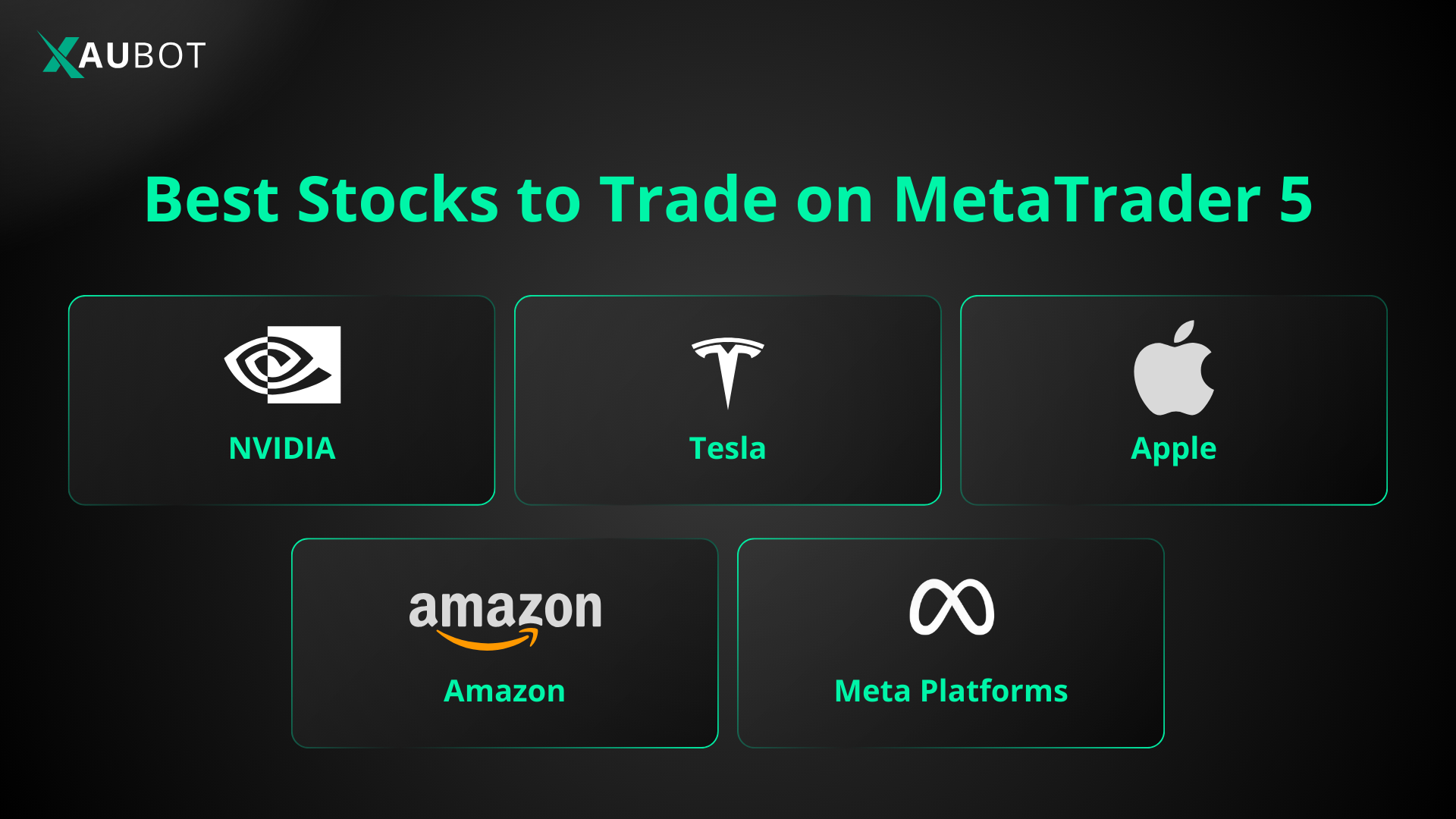
Seven of the Best Stocks to Trade on MetaTrader 5
These stocks are consistently among the most actively traded in the US, and most MT5 brokers that offer stocks list them. Trading volume changes over time, so check current volume and your broker’s spread before trading any of them.
NVIDIA (NVDA)
The chipmaker at the center of the AI hardware boom, and one of the most heavily traded US stocks. NVIDIA tends to make large intraday moves and reacts strongly to its own earnings and to news about AI spending across the sector.
- Suits: momentum and breakout strategies.
- Watch out for: large earnings gaps and fast reversals after big runs.
Tesla (TSLA)
One of the most volatile large caps, driven by delivery numbers, earnings, product news and headlines about its chief executive. Tesla offers big moves, but also some of the widest swings against a position.
- Suits: experienced short term traders who size positions small.
- Watch out for: sudden headline moves and wide daily ranges that can hit tight stops.
Apple (AAPL)
One of the largest companies in the world by market value, with deep liquidity and generally steadier movement than NVIDIA or Tesla. Apple often respects key moving averages and support and resistance levels.
- Suits: trend following and pullback strategies.
- Watch out for: smaller daily ranges, which leave less room after costs for very short trades.
Microsoft (MSFT)
A large, steady technology stock driven by cloud and software results. Like Apple, it tends to move in a more orderly way than the high volatility names.
- Suits: swing trading and multi timeframe trend strategies.
- Watch out for: quiet periods with little intraday movement.
Amazon (AMZN)
Online retail and cloud computing make Amazon sensitive to both consumer spending data and technology sector news. It is liquid throughout the session, with moderate volatility.
- Suits: pullback entries and mean reversion within the day.
- Watch out for: sharp moves on earnings, which cover both its retail and cloud businesses.
Meta Platforms (META)
The owner of Facebook, Instagram and WhatsApp, driven mainly by advertising revenue and spending plans. Meta can trend strongly for long periods and gap hard on earnings.
- Suits: trend and breakout strategies.
- Watch out for: some of the largest earnings gaps among big tech stocks.
AMD (AMD)
A chipmaker that often moves with NVIDIA and the wider semiconductor sector, usually with high volatility for a large company.
- Suits: momentum traders who want semiconductor exposure.
- Watch out for: sector wide moves that can turn quickly.
The Seven Stocks Compared
| Stock | Typical volatility | Main drivers | Best fit |
|---|---|---|---|
| NVIDIA | High | AI demand, earnings | Momentum, breakouts |
| Tesla | Very high | Deliveries, headlines | Small size, short term |
| Apple | Moderate | Product cycle, earnings | Trend, pullbacks |
| Microsoft | Moderate | Cloud, software results | Swing, trend |
| Amazon | Moderate | Consumer data, cloud | Pullbacks, mean reversion |
| Meta | High on earnings | Ad revenue, spending | Trend, breakouts |
| AMD | High | Chip sector news | Momentum |
Volatility here is relative to other large caps, and it changes over time. Use a tool like ATR to measure each stock’s current movement before choosing stop distances. Our guide to trending and ranging markets explains how to match a strategy to the conditions a stock is in.
When You Can Trade US Stocks on MT5
Unlike forex, stocks only trade during exchange hours. The regular US session runs from 9:30 a.m. to 4:00 p.m. New York time, Monday to Friday, which is 13:30 to 20:00 UTC while the US is on daylight saving time and 14:30 to 21:00 UTC in winter. US exchanges also close for public holidays, which are listed on the NYSE holiday and trading hours calendar.
| Period | What usually happens |
|---|---|
| First 30 to 60 minutes | The biggest moves and volume of the day, with wider spreads at the open |
| Midday | Quieter, smaller ranges |
| Last hour | Volume returns as funds adjust positions before the close |
| Overnight and weekends | No trading on most MT5 brokers, so price can gap at the next open |
Many brokers do not offer pre market or after hours trading on MT5, so news released outside the session shows up as a gap at the open.
The Costs of Trading Stocks on MT5
- Commission. Many brokers charge per share or as a share of trade value, on top of or instead of the spread.
- Spread. Usually tightest in the most liquid names and widest at the open and around news.
- Swap. Holding a stock CFD overnight costs a financing charge, which adds up on longer trades.
- Dividend adjustments. On the dividend date, short positions are usually charged the dividend amount and long positions credited.
Worked example: sizing a stock CFD trade
Say you have a $5,000 account and risk 1%, or $50. You buy a stock at $200 with a stop $6 below, based on its recent ATR.
- Shares. $50 ÷ $6 = about 8 shares.
- Lot size. If your broker sets 1 lot as 1 share, that is 8 lots. If 1 lot is 100 shares, it is 0.08 lots. Always check the contract size.
- Position and margin. 8 shares × $200 = $1,600. At 1:5 leverage, the margin is about $320.
Now suppose the company reports earnings overnight and the stock opens $15 lower. Your stop cannot fill at $194 because the market never traded there, so it fills near the open. The loss is about 8 × $15 = $120, which is 2.4% of the account instead of the planned 1%.
This is the biggest difference from forex. Many traders cut position size before earnings, or close positions before the release. Our guide to lot sizes and leverage for small accounts covers sizing in more detail.
Using Trading Bots on Stocks in MT5
An Expert Advisor can trade stocks on MT5 just as it trades currency pairs, but a few settings need extra attention:
- Trading hours. Limit the bot to the regular session, and consider skipping the first few minutes after the open when spreads are widest.
- Earnings dates. A bot does not know an earnings report is coming. Pause it or reduce size around each company’s release.
- Gap protection. Close positions before the session ends, or accept that stops can fill far from their level at the next open.
- Symbol names. Brokers name stock symbols differently, such as NVDA, NVDA.US or #NVDA. Make sure the bot is set to the exact name.
- Account type. Check whether the bot needs a hedging account, since real share accounts on MT5 are often netting.
Strategies that add positions as price moves against you, such as grid or multi level methods, carry extra risk on single stocks. A company specific shock, like a bad earnings report, can move price far beyond what those methods are designed to handle. Test on several years of data, including earnings periods, before trading live. Our guide on how to backtest your expert advisor shows how.
XAUBOT for Stocks and Indices
XAUBOT is our own platform. Stocks are covered under the indices market, alongside benchmarks such as US30 and US500, and you can see the details on our indices trading bot page.
- Customization. You customize a prebuilt bot from ten fixed strategies, including MACD and EMA Trend, Momentum Pullback and EMA, and VWAP Reversion, then set its risk.
- Methods. Choose Scalp or Multi Level. Scalp bots come with fixed trading hours that you can adjust, which suits stock session times.
- Risk settings. Stop loss, take profit and daily drawdown controls are built in.
- Requirements. A hedging account on MT4 or MT5, with a VPS recommended.
One bot can be set to trade several symbols. Given the gap risk above, many traders find that a diversified index is easier to automate than a single stock. Every bot works on both platforms, and you can download it from our MetaTrader 5 page and test it free for 15 days on demo.
Stock Trading on MT5 Questions
Can you trade stocks on MetaTrader 5?
Yes, if your broker offers them. Most offer stock CFDs, and some offer real shares. Check which stocks your broker lists, since the selection varies widely.
Why can’t I see stocks in my MT5 Market Watch?
Your account type may not include them, or they may be hidden. Right click Market Watch, choose Symbols, and search for the stock. If it is not there, your broker or account type does not offer it.
What is the best time to trade US stocks on MT5?
The first hour after the 9:30 a.m. New York open and the last hour before the 4:00 p.m. close usually have the most movement and volume. Midday tends to be quieter.
Are stock CFDs riskier than forex?
They carry different risks. Leverage is usually lower, but single stocks can gap sharply overnight on earnings or company news, which happens less often in major currency pairs.
Final Word
The best stocks to trade on MetaTrader 5 combine high liquidity, enough daily movement and low costs at your broker. Large US technology names usually fit best, but the bigger risk is the gap at the open, not the spread. Size positions for that gap, plan around earnings, and test any bot on demo first.
Trading stock CFDs with leverage carries a high risk of loss. Only trade with money you can afford to lose.