

Key Takeaways
- The 1% rule limits risk on each trade. It means risking no more than 1% of your account balance on a single trade, which equals $10 on a $1,000 account.
- The 90% rule is a popular trading claim, not a verified statistic with those exact numbers. The claim says 90% of traders lose 90% of their money in 90 days, but no study supports that precise formulation. EU regulators have found that 74% to 89% of retail CFD accounts lose money.
- Risk per trade has a major impact on account survival. Ten consecutive losses at 1% risk would cost approximately 9.6% of the starting balance, while risking 10% of the remaining balance per trade would result in a loss of about 65% over the same streak.
- Lot size helps put risk limits into practice. A trading bot can apply position-sizing rules consistently on every trade, but no setting can eliminate market risk.

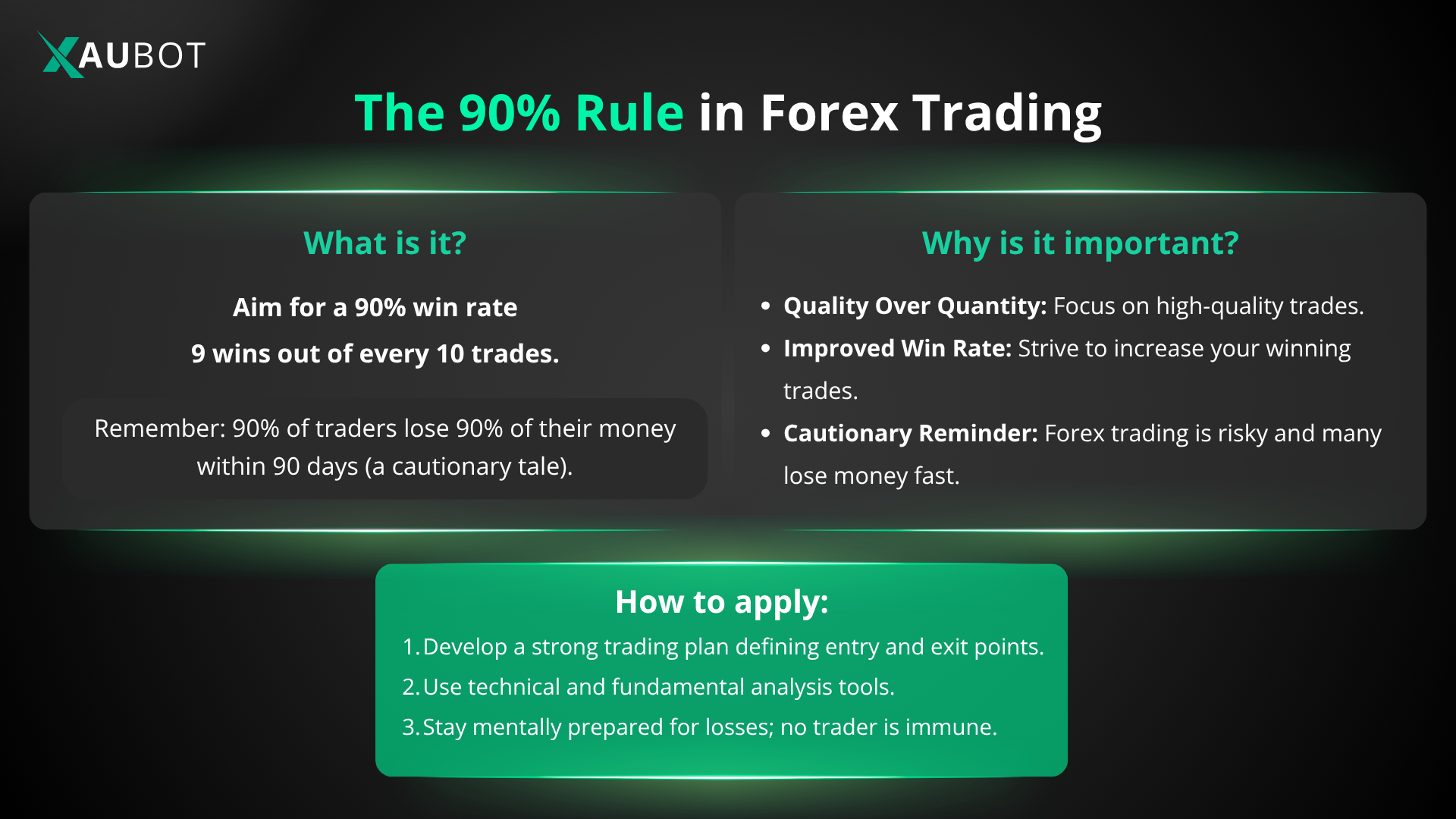
The 1 and 90 rules in forex trading are two rules of thumb about risk. The 1% rule says never risk more than 1% of your account on a single trade. The 90 rule warns that 90% of new traders lose 90% of their money within 90 days.
The first is a sizing method you can use today. The second is a slogan with no study behind its exact numbers, yet the real loss rates are not far off.
Below, we break down both rules with worked examples, the data behind the warning, and a checklist you can run before every trade.
Is the 90 Rule True? What the Loss Data Shows
No published study measures the “90% of traders lose 90% in 90 days” claim. It is a trading folk saying. The useful question is how close it comes to the real numbers.
The closest hard data comes from Europe. Across the EU, regulators’ analyses found that 74% to 89% of retail CFD accounts typically lost money, with average losses per client of €1,600 to €29,000. A CFD (contract for difference) is a leveraged contract that tracks a price, and much retail forex and gold trading outside the US runs through them.
Those findings, published in March 2018, led the EU to cap retail leverage and require every CFD broker to publish the share of its own retail accounts that lose money. Look for that figure on your broker’s website before you deposit.
| Part of the 90 rule | What the data shows |
|---|---|
| 90% of traders lose | 74% to 89% of retail CFD accounts lost money in EU regulators’ studies |
| They lose 90% of their money | Average losses per client ranged from €1,600 to €29,000, not a fixed 90% |
| Within 90 days | No study supports a 90 day window, and the long term picture is worse, not better |
Staying longer did not help
The 90 day part suggests losers wash out quickly and survivors do fine. A study of all 19,646 people who started day trading Brazilian index futures between 2013 and 2015 found the opposite.
| Days spent day trading | Share who made a net profit |
|---|---|
| 1 day | 29.8% |
| 2 to 50 days | 15.5% |
| 51 to 100 days | 8.9% |
| 101 to 200 days | 6.8% |
| 201 to 300 days | 5.4% |
| More than 300 days | 3.0% |
That market was equity index futures, not forex, so treat it as a guide rather than a forex statistic. The lesson still carries over: persistence without an edge and tight risk control does not turn losses into profits.
The 90% win rate misreading
Some articles explain the 90 rule as aiming for a 90% win rate. That is a misreading, and a costly one. Win rate means nothing without the size of wins and losses.
Take 10 trades with 9 wins of $10 and 1 loss of $100. The win rate is 90%, yet the account is down $10. Strategies that chase a very high win rate often do it by holding losers too long, which is exactly how accounts lose 90%.
The 1% Rule: How to Size Every Trade
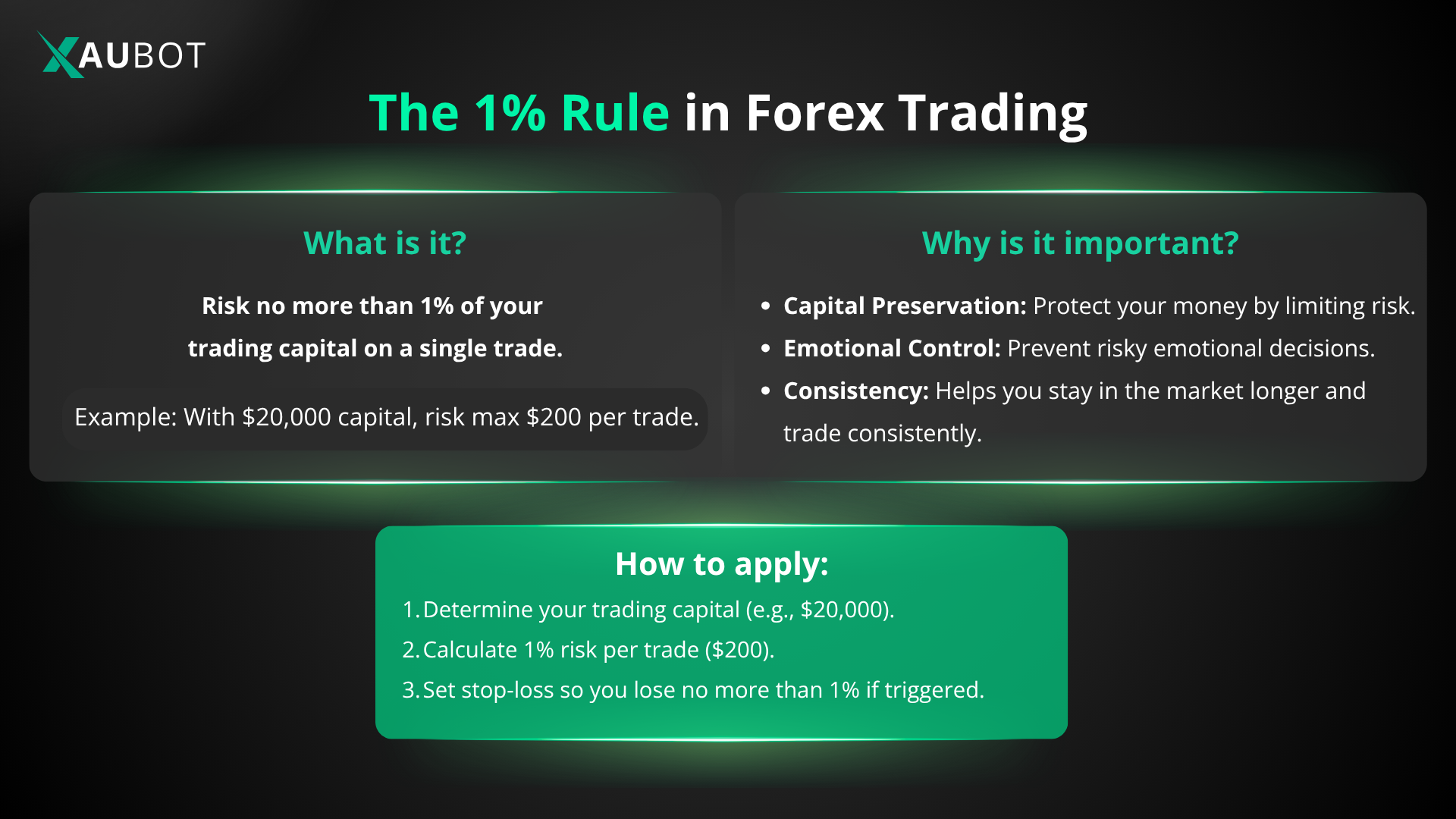
The 1% rule caps the loss on any single trade at 1% of your account balance. You set the stop loss first, where the trade idea is proven wrong, then choose a lot size so that hitting the stop costs no more than 1%.
The formula is simple: lot size = (account balance × 1%) ÷ (stop distance × value of that distance for 1 lot). Always round the result down, never up.
Worked example: EUR/USD
You have $1,000 and want to buy EUR/USD with a stop 20 pips below entry. Your maximum risk is 1% of $1,000, which is $10.
On EUR/USD, one standard lot (100,000 units) moves about $10 per pip. A 20 pip stop on 1 lot would cost $200, so your lot size is $10 ÷ $200 = 0.05 lots.
Worked example: gold (XAU/USD)
You have $5,000 and want to buy gold with a stop $8 below entry. Your maximum risk is $50.
At many brokers, 1 lot of gold is 100 ounces, so every $1 move is worth $100 per lot. An $8 stop on 1 lot costs $800, and $50 ÷ $800 = 0.0625, which rounds down to 0.06 lots. Contract sizes vary, so check your broker’s specification first.
What 1% looks like on different account sizes
This table uses the EUR/USD example above: a 20 pip stop and about $10 per pip per standard lot.
| Account balance | 1% risk | Exact lot size | Lot size you can open | Actual risk |
|---|---|---|---|---|
| $100 | $1 | 0.005 | 0.01 (minimum) | $2 (2%) |
| $500 | $5 | 0.025 | 0.02 | $4 (0.8%) |
| $1,000 | $10 | 0.05 | 0.05 | $10 (1%) |
| $5,000 | $50 | 0.25 | 0.25 | $50 (1%) |
| $20,000 | $200 | 1.00 | 1.00 | $200 (1%) |
The first row matters for small accounts. Most brokers’ smallest trade is 0.01 lots, so a $100 account cannot hold 1% risk on a 20 pip stop. You either accept 2%, use a tighter stop the market structure supports, or find a broker that offers smaller contract sizes.
Use your current balance, not your starting balance. After losses your 1% shrinks, which slows the damage, and after gains it grows with the account.
How the 1 and 90 Rules in Forex Work Together
The 90 rule describes the outcome most retail traders reach. The 1% rule is the main defense against it. The link between them is the losing streak.
Every strategy has runs of losses. If a strategy wins half its trades, the chance of at least one run of 10 straight losses somewhere in 1,000 trades is close to 40%. What that run does to your account depends almost entirely on your risk per trade.
| Risk per trade | Balance left after 5 losses | After 10 losses | After 20 losses |
|---|---|---|---|
| 1% | 95.1% | 90.4% | 81.8% |
| 2% | 90.4% | 81.7% | 66.8% |
| 5% | 77.4% | 59.9% | 35.8% |
| 10% | 59.0% | 34.9% | 12.2% |
Each loss is taken from the balance that remains, which is why the 1% row never reaches zero. At 10% per trade, 20 straight losses leave about 12% of the account, which is the 90 rule playing out in real numbers.
Why deep losses are so hard to undo
A loss and the gain needed to recover it are not the same size. The deeper the hole, the steeper the climb out.
| Account loss | Gain needed to get back to the start |
|---|---|
| 10% | 11.1% |
| 25% | 33.3% |
| 50% | 100% |
| 75% | 300% |
| 90% | 900% |
A trader who loses 90% needs to grow the remaining 10% tenfold just to break even. Small, fixed risk per trade keeps you in the top rows of this table, where recovery is still realistic.
Applying the Rules When a Bot Trades for You
An Expert Advisor (EA) sizes every trade from its settings, so it will not double its lot size to win back a loss unless you tell it to. That makes a bot a strong tool for the 1% rule, as long as the settings are right.
XAUBOT is our own platform, so read this section with that in mind. You start from a prebuilt bot, then customize risk settings, position sizing, drawdown limits, symbols, trading hours and the news filter to match your trading style. The finished bot runs on MetaTrader 5 or MetaTrader 4.
Three settings deserve a second look, whichever bot you use:
- Total open risk. One bot can trade several symbols at once, so five open trades at 1% each can cost up to 5% in a bad hour. Correlated pairs such as EUR/USD and GBP/USD often move together, and our guide to running multiple forex trading bots on one account covers how to cap this.
- Layered entries. Multi Level strategies open several positions in steps. Apply the 1% rule to the whole group of positions, not to each order on its own.
- Leverage. Under EU rules, retail leverage is capped at 30:1 on major currency pairs and 20:1 on gold. Leverage does not change your risk when the stop sets the lot size, but it lets you open far larger positions than the rule allows, as our guide on how leverage works in forex explains.
Gold usually needs more room than currency pairs, so its stops are wider in dollar terms and its lot sizes smaller. If you plan to automate it, start with our gold trading bot for XAU/USD page, or the forex trading bot page for currency pairs.
A 60 Second Checklist Before Every Trade
Run through these before you place a trade by hand or switch a bot on. If any answer is no, fix it first.
- I know my current balance and the dollar value of 1% of it.
- My stop loss sits where the trade idea is proven wrong, not where the money feels comfortable.
- My lot size is calculated from that stop and rounded down.
- My total risk across all open trades stays under a cap I set in advance, for instance 3%.
- I have a daily loss limit, and I stop trading for the day when I hit it.
- I have checked for high impact news during the trade, or my bot’s news filter is on.
- I know the share of retail accounts that lose money at my broker.
- I have tested this setup on a demo account before using real money.
Questions Traders Ask About the 1 and 90 Rules
What is the 1% rule in forex?
It is a risk limit: you never lose more than 1% of your account balance on a single trade. On a $2,000 account that is $20, and your lot size is set so that hitting the stop loss costs no more than that.
Is it true that 90% of forex traders lose money?
The exact “90% lose 90% in 90 days” claim has no study behind it. Regulator data from across the EU found 74% to 89% of retail CFD accounts lost money, so the real picture is close to the saying, just not as tidy.
Is 2% per trade too much?
Not always, but the gap compounds. After 10 straight losses, 1% risk leaves about 90% of the account, while 2% leaves about 82%. Beginners and anyone running several positions at once are usually better served at 1% or below.
Can I follow the 1% rule with a $100 account?
Only with tight stops. The smallest lot at most brokers is 0.01, which risks $2 on a 20 pip EUR/USD stop, or 2% of $100. Your choices are to accept 2% until the balance grows, or to take only setups that allow a tighter stop.
Does the 1% rule stop me from blowing my account?
It makes it much less likely, but it is not a guarantee. Prices can gap past your stop during news or over a weekend, so a 1% risk trade can occasionally lose more.
Can a trading bot follow the 1% rule for me?
Yes, if its risk setting is based on account balance and stop distance. Check how the bot counts risk on layered or multi symbol trades, and test it on a demo account before going live.
Before You Risk Real Money
Forex, gold and CFD trading with leverage carries a high risk of loss, and you can lose money quickly. The 1% rule limits how fast losses build, but it does not make a losing strategy profitable. Only trade money you can afford to lose.
If you are wondering what returns are realistic at 1% risk, our breakdown of whether it is possible to make $1000 a day in forex runs the numbers by account size.
A practical next step: choose one or two markets, customize a bot with XAUBOT to match your trading style, and set risk per trade at 1% or lower. Run it on a demo account first. Our 15 day free trial works on demo accounts and needs no credit card, so you can watch how the settings behave through a few losing streaks before any real money is involved.