

Key Takeaways
- A VPS keeps your Expert Advisor running continuously. It operates from a remote data center, so your bot can keep trading even when your computer is off, asleep, or disconnected from the internet.
- Most retail EA strategies work comfortably with 10ms latency or lower. Only ultra-fast scalping or news trading strategies typically need to pursue significantly lower latency.
- A basic trading VPS typically costs $15 to $40 per month. Around 2GB of RAM and two CPU cores are usually sufficient for running one to three EAs at the same time.
- A VPS becomes important when your bot needs to trade unattended. It is particularly useful for overnight or news-event trading, but may not be necessary when you are simply testing a strategy on a demo account that you actively monitor.
The Actual Question Being Asked
“Do I need a VPS” is really two separate questions wearing one sentence. The first is technical: can your EA keep trading without one. The second is practical: what happens to your results if it can’t. Answering the first question honestly makes the second one easy.

An Expert Advisor only trades while the platform running it, MetaTrader 4 or MetaTrader 5, stays open and connected to your broker. Close your laptop, and the platform closes with it. Your internet drops for ten minutes during a busy afternoon, and your EA is offline for those ten minutes, unable to open new trades, manage existing ones, or react to anything happening in the market. A VPS, short for Virtual Private Server, solves this by running your trading platform on a separate, dedicated machine that sits in a data center and stays on permanently. You connect to it remotely, set up MetaTrader, and let it run. Your own laptop can go to sleep, lose signal, or get shut off entirely, and your EA keeps trading uninterrupted.
What a VPS Actually Changes About Your Trading
Two things matter here related to the role of a VPS, and they are easy to mix up: uptime and latency.
Uptime is simply whether your EA is running at all. Most VPS providers advertise uptime guarantees in the 99.9% to 99.99% range. That sounds close enough to perfect that the difference feels irrelevant, until you do the arithmetic. 99.9% uptime allows for roughly 8 to 9 hours of downtime across a full year. In forex, where a single major news release can move a currency pair several pips in one second, 8 hours of unplanned downtime landing at the wrong moment, say during a central bank announcement, is not a rounding error. It is a real gap in coverage.
Latency is the round trip time between your VPS and your broker’s server, measured in milliseconds. This determines how quickly your orders actually reach the broker once your EA decides to act. For most retail automated strategies, latency under 10 milliseconds is considered solid, and general trading remains workable up to around 20 milliseconds. Above roughly 50 milliseconds, execution quality noticeably starts to degrade. The traders who genuinely need to chase latency into the low single digits are running fast scalping strategies or news trading systems reacting to releases like NFP, where price can move several pips within a single second and every millisecond of delay becomes a small, compounding cost in slippage.
When a VPS Is Genuinely Necessary
There is a fairly clear line here, and it comes down to whether your forex trading robot needs to trade unattended.
- You run your EA overnight or across sessions you are not awake for. Since forex trades continuously across time zones, a strategy that only trades while your laptop happens to be open is missing a meaningful portion of its own opportunities, and possibly getting caught mid trade when you close it.
- Your strategy holds positions that need active management around news events. A trade with a stop loss and take profit already set can survive some downtime. A strategy designed to actively manage exits around a scheduled release cannot.
- You are trading with real capital rather than just testing. The cost of a missed connection during live trading is a missed trade, or worse, an open position with no one and nothing managing it.
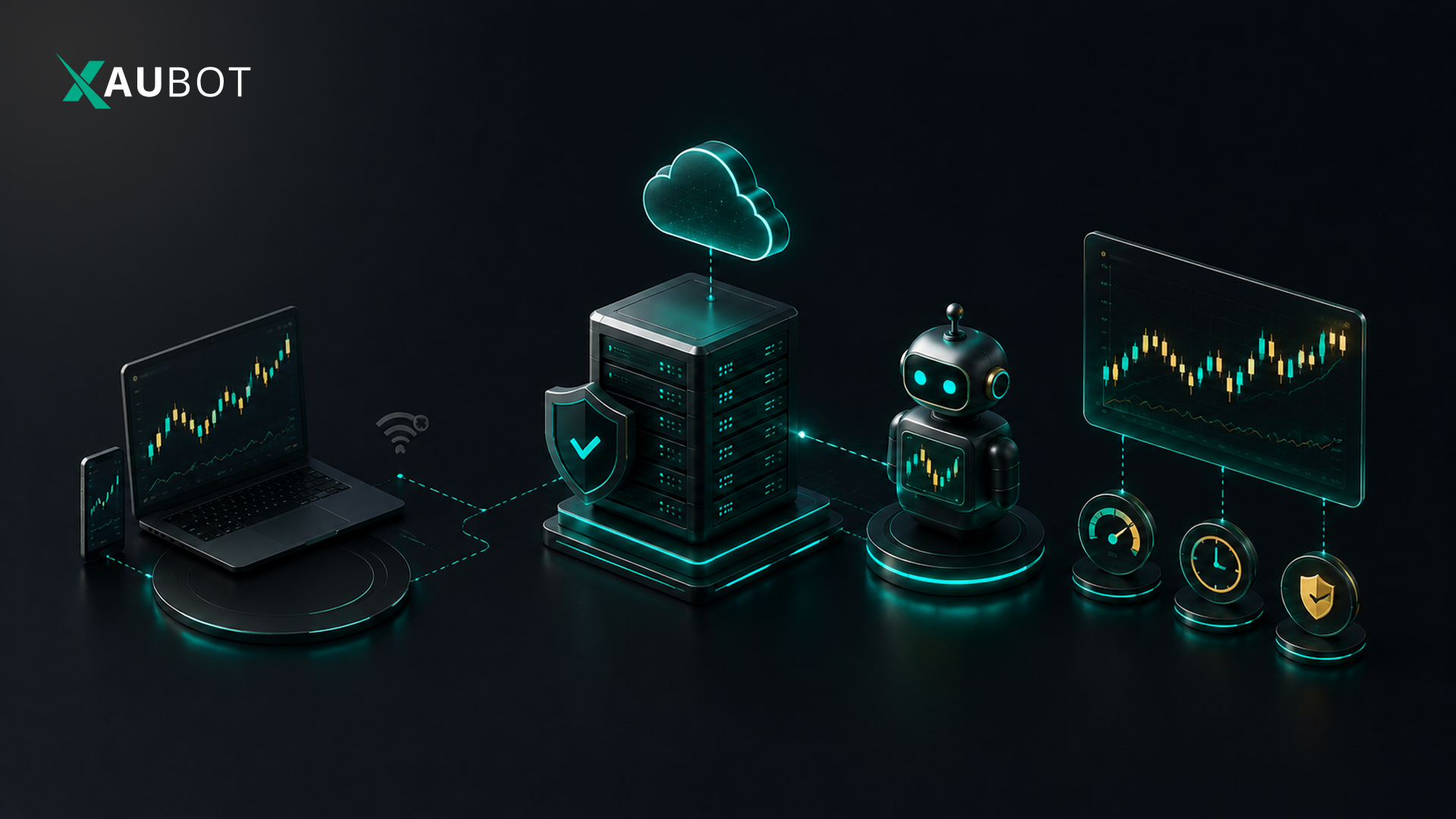
VPS Requirements for XAUBOT: Multi Level vs Scalp
This distinction matters specifically for traders running XAUBOT’s own bot types, since Multi Level and Scalp actually have different VPS requirements.
Multi Level genuinely needs a VPS, no exceptions. A Multi Level strategy works by managing multiple price levels simultaneously, opening and adjusting positions as price moves through each one. If the system running it goes offline, even briefly, the bot cannot manage those levels, and a level that needed to be opened or adjusted at a specific moment simply gets missed. There is no way to make up for that gap afterward. This is exactly why Multi Level requires continuous, uninterrupted uptime, which a VPS is built to provide.
Scalp is more flexible, because it trades on a fixed daily schedule rather than continuously. If Scalp is set to trade during a specific window, for instance 4 hours a day, a trader can reasonably skip a VPS as long as their computer is on and MetaTrader is actively running during that exact window. Outside of it, there is nothing for the bot to miss, since it is not scheduled to trade anyway.
One important caveat here, and it catches people off guard: keeping your computer powered on is not the same as keeping it usable for this purpose. When a PC goes to sleep, MetaTrader stops running along with everything else. The bot cannot analyze the market, cannot open or modify trades, and the internet connection itself may be suspended. So even if MetaTrader was never manually closed, a PC that has gone to sleep means the bot is not actually working, regardless of what the screen suggests. If you are relying on your own computer to run Scalp during its scheduled window instead of using a VPS, sleep mode needs to be disabled for that window, not just avoided by leaving MetaTrader open.
When You Can Reasonably Skip It
The counterpoint matters too, since not every situation calls for a VPS on day one.
If you are still testing a strategy on a demo account, actively watching it, and not yet running real capital, a VPS is a convenience rather than a requirement. Nothing catastrophic happens if a demo EA goes offline for an afternoon. The same is true for very early stage evaluation of a new bot, where the goal is simply to observe behavior over a short window rather than capture every possible trade. Once that testing phase ends and you move to live capital or unattended overnight trading, the calculation changes.
What to Actually Look For
If the answer comes out to yes, the specifications that matter most are simpler than most comparison pages make them sound.
- RAM and CPU. For running one to three EAs on MT4 or MT5, 2GB of RAM and two CPU cores is generally sufficient. Running more EAs or heavier multi chart setups calls for more.
- Location relative to your broker. A VPS physically closer to your broker’s server location will show meaningfully lower latency than one on the other side of the world. A VPS in London connecting to a London based broker might see 1 to 2 milliseconds of latency. The same VPS connecting to a broker with servers in another region entirely could see well over 100 milliseconds.
- Windows Server support. MetaTrader is built for Windows, so most trading specific VPS providers run Windows Server rather than Linux.
- Realistic pricing. A functional trading VPS with the specifications above typically runs $15 to $40 a month. Providers charging far less than that are usually cutting corners somewhere, often shared, oversubscribed hardware where other users’ heavy activity can slow down your own EA’s performance without warning.
Check out the list for the best VPS providers for 2026
VPS Versus Colocation: A Distinction Worth Knowing
One thing worth clearing up, since the terms sometimes get used loosely: a VPS is not the same thing as colocation. Colocation means placing a dedicated physical server inside the same building as your broker’s actual matching engine, cutting latency down to the low single digit millisecond range or below. This is genuinely necessary for latency arbitrage strategies, where the entire edge depends on reacting within 2 to 4 milliseconds, faster than almost any retail strategy requires. Colocation also costs $1,000 to $10,000 or more per month once rack space, power, and network cross connects are factored in, and it is neither accessible nor necessary for the overwhelming majority of retail traders. A standard VPS, sitting in the same metro area as your broker rather than the exact same building, gets latency low enough for essentially every retail strategy that isn’t chasing microsecond level arbitrage, at a small fraction of the cost.
A Note for Traders Running a Ready-Made Bot
If the EA in question is a ready-made bot rather than something built from scratch, this decision connects to an earlier question worth revisiting: what infrastructure was the bot’s existing track record actually built on. A verified live account with a strong history was very likely already running on stable, low latency infrastructure, since a bot dropping offline every time a home laptop went to sleep would show up as gaps and inconsistency in its own results. Matching that same level of reliability on your own end, generally by running the bot on a proper VPS rather than a personal computer, is part of giving a proven strategy a fair chance to perform the way its track record suggests it can.
The Honest Bottom Line
A VPS is not a magic performance upgrade, and it will not make a poorly designed strategy profitable. What it does is remove one specific point of failure: your own hardware and internet connection as the thing standing between your EA and continuous market access. For a bot trading real money unattended, particularly overnight or around scheduled news events, that reliability is not optional, it is part of running the strategy responsibly in the first place. For a strategy still being tested and actively watched, it is a reasonable expense to delay until you are confident enough in the bot to let it run without you.