Key Takeaways
- Signal services tell you what to trade. You remain responsible for placing, managing, and closing every order yourself.
- Copy trading mirrors another trader’s account. Their trading decisions are replicated in your account, so your results depend heavily on their performance and risk-taking.
- Trading bots follow rules you can review and adjust. They offer greater control over automated decisions, but require careful configuration and testing.
- Choose the approach that fits your circumstances. Consider your available time, desired level of control, and account size, then test your approach on a demo account before trading live.
In the trading bots vs copy trading vs signal services question, the right answer depends on two things: how much control you want and how much time you have. Signal services suit traders who want ideas but still enjoy pressing the button. Copy trading suits people willing to hand decisions to someone else, while a trading bot suits traders who want clear rules they can inspect and change.

None of the three is a shortcut to profit. Each one moves a different job off your plate and leaves a different risk behind.
Our team works with traders setting up automation every day. A pattern we notice often is people picking a tool first and only later asking whether it fits their week, budget and temperament. This guide flips that order, using real fee structures as of October 2026.
Three Ways to Hand Off Part of Your Trading
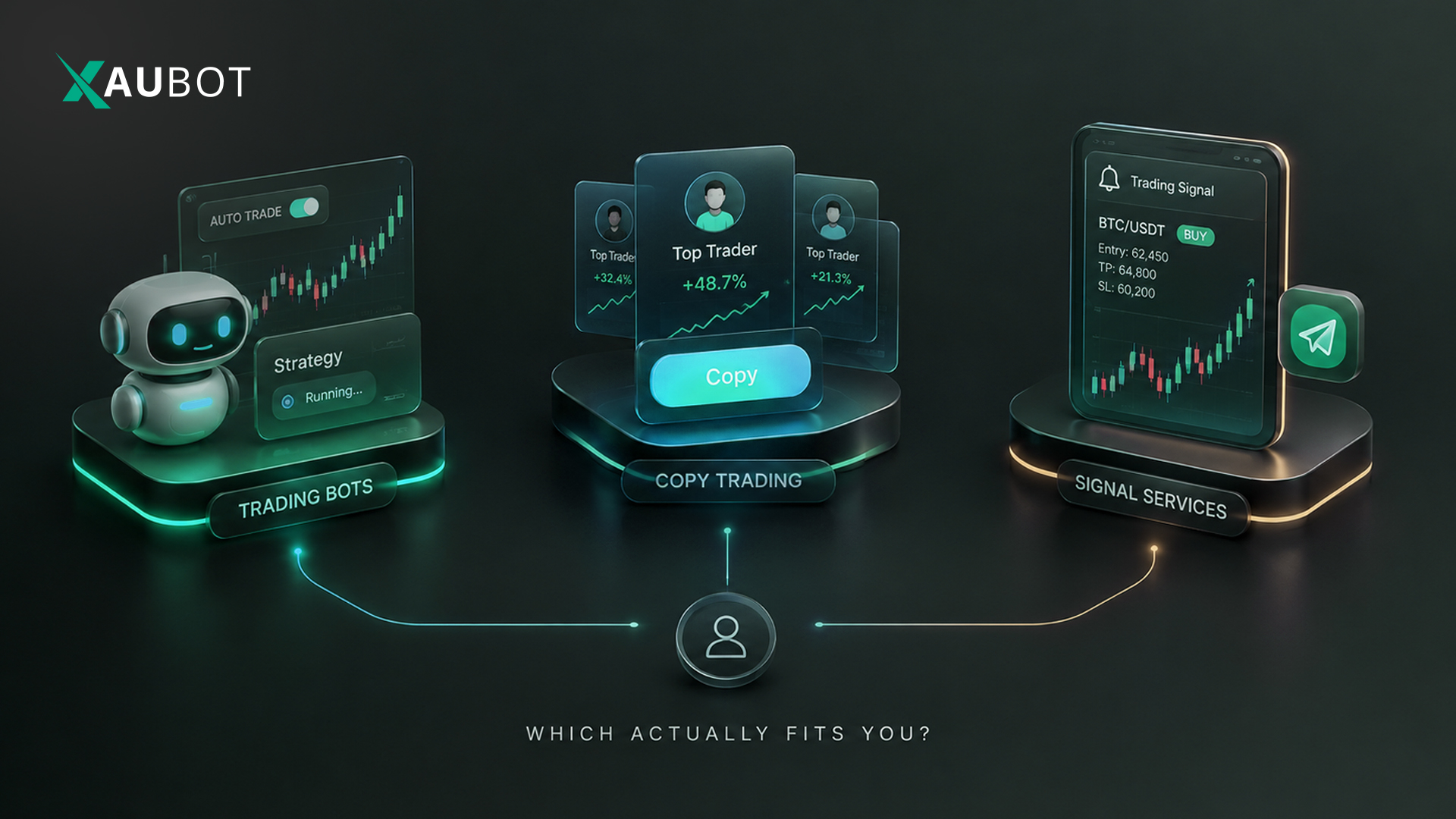
The three options sound similar because all of them promise to save effort. The real difference is which job you give away: the idea, the execution or the rules.
Signal services: someone else’s idea, your execution
A signal service sends trade ideas, usually an entry price, a stop loss and a take profit level. They arrive through Telegram, email or an app. You decide whether to take each trade, then open and manage it yourself.
This keeps you in the loop on every position. It also means your results depend on how quickly you react when a message lands.
Copy trading: someone else’s idea and execution
Copy trading connects your account to a provider’s live account. When the provider opens or closes a trade, the platform repeats it in your account automatically, scaled to your balance.
One detail confuses many traders. The “Signals” service built into MT4 and MT5 is actually copy trading, because trades are copied automatically rather than sent as alerts to act on.
Trading bots: your rules, automated execution
A trading bot, called an Expert Advisor on MetaTrader, is software that opens and closes trades by fixed rules. It runs inside your own terminal and never asks anyone for permission.
On XAUBOT, traders start from a prebuilt bot with strategy options such as Scalp and Multi Level. They then customize risk per trade, symbols, trading hours and the news filter. You choose the rules, the bot applies them the same way every time.
Trading Bots vs Copy Trading vs Signals at a Glance
The table below compares the three on the points traders ask us about most. Read it row by row and notice where you need a specific answer.
| Factor | Signal service | Copy trading | Trading bot |
|---|---|---|---|
| Who decides each trade | The provider | The provider | Rules you choose |
| Who places the order | You, by hand | The platform, automatically | The bot, automatically |
| Daily time needed | High, you must react to alerts | Low, a weekly review | Low to medium, regular monitoring |
| Can you see the logic | Rarely | Only through past trade history | Yes, every setting is visible |
| Typical cost model | Monthly subscription | Subscription or fees on profit, equity or volume | License plus hosting |
| Biggest hidden risk | Late entries and missed alerts | The provider changes how much risk they take | Settings that no longer suit the market |
| What you learn | Some, if the provider explains trades | Very little | A lot, from testing your own rules |
The pattern is simple. Reading from left to right, from signals to bots, you give away less judgment and keep more responsibility for the setup.
What Each Option Really Costs in 2026
The sticker price is only part of the bill. How each fee is charged matters as much as its size, especially on smaller accounts.
Signal services: a fixed fee, win or lose
Paid signal groups in 2026 commonly charge anywhere from about $30 to well over $200 a month. The fee stays the same whether the month ends up or down.
You also pay with your time. A gold signal that arrives while you are in a meeting can be worth little once price has moved a few dollars.
Copy trading: fees that scale with your account
Copy trading platforms use three main fee types. As of October 2026, one widely used platform caps them like this:
- Performance fee: up to 30% of profit, charged only on new equity highs (the “high water mark” rule).
- Management fee: up to 10% of your equity per year, charged whether the strategy wins or loses.
- Volume fee: a set amount per million units traded, charged when a trade opens and again when it closes.
The Signals service inside MT4 and MT5 works differently. You pay a fixed subscription for the whole period upfront, and a canceled subscription is not refunded. Each trading account can follow only one provider, and providers with leverage above 1:500 are not available to copy.
Trading bots: a license plus somewhere to run it
A bot needs a license and a computer that stays online. XAUBOT offers a 15 day free trial on a demo account with no card required. The Yearly plan is listed at $99 (down from $299) with 5 live licenses, and Lifetime is $499 once with 10 licenses.
Hosting is the second cost. MetaTrader’s built in virtual hosting runs about $10 to $15 a month in 2026, though you can also run a bot on your own PC if it stays on.
Where the Risk Hides in Each Approach
Start with what all three share: the market itself. Mandatory risk warnings at major regulated brokers in 2026 show roughly 60% to 77% of retail CFD accounts losing money. No delivery method changes how leverage works.
The signal gap
With signals, the main danger sits between the message and your order. A scalping signal on XAU/USD can move several dollars before you open your app, turning a planned 1:2 trade into a poor one.
Quality is another issue. Many free channels post entries without a stop loss, and in 2025 Cyprus’s financial regulator added Telegram signal channels to its warning list of unauthorized firms.
The copy trading blind spot
When you copy, you inherit a stranger’s risk appetite, and it can change without notice. A provider who risked 1% per trade for a year can start doubling position sizes after a losing streak.
Your results will also differ from the provider’s. Spreads, execution speed and broker conditions vary, and missed connections can mean missed trades.
In March 2023, the EU securities regulator said copy trading services can count as portfolio management or investment advice. That brings strict suitability rules for the firms offering them, so check that your platform is properly authorized before you copy anyone.
The bot settings trap
A bot does exactly what you tell it, including the mistakes. The most common problem we see in setups is risk per trade set too high for the account size.
Market conditions matter too. Rules that suited a trending gold market can struggle in a choppy range. The difference is that you can see the cause and change a setting, rather than guessing what someone else is doing.
Four Questions That Point to Your Best Fit
Answer these honestly before you pay for anything. Often, one option drops out within the first two questions.
1. How many hours a day can you actually watch the market?
Signals only work if you can act within minutes. Gold is most active during the London and New York sessions, so a trader with a full time job in those hours will miss many alerts.
If your screen time is limited, copy trading or a bot is the more realistic choice.
2. Do you need to understand why each trade happened?
Some traders are comfortable not knowing. Others lose sleep over a trade they cannot explain.
If you need the why, copy trading will frustrate you. A bot gives you visible rules, and signals give you a provider’s reasoning when they share it.
3. How large is the account you plan to use?
On small accounts, fixed monthly fees take a big bite, as the worked example showed. Percentage fees start low but grow as your balance grows.
Run the numbers for your own balance before choosing. A cost that looks small in dollars can be large as a share of your account.
4. How will you react to a losing month?
Every approach has losing stretches. The question is whether you will stay calm or switch tools at the worst moment.
A loss you can trace to a setting is easier to manage than one you cannot explain. That is why we encourage traders to define their trading style first, then fit a bot to it. With XAUBOT, one bot can also run several symbols, so you can match it to the markets you already know.
Straight Answers to Common Questions
Is copy trading safer than using a trading bot?
Neither is safer by default. Copy trading puts your risk in a provider’s hands, while a bot’s risk depends on the settings you choose. Either can lose money quickly if the risk per trade is too high.
Are trading signals the same as copy trading?
No. A signal is a trade idea you decide on and place yourself. Copy trading places the provider’s trades in your account automatically, even though some platforms label it “signals.”
Can I run a trading bot and copy trading on the same account?
It is best to keep them on separate accounts. On the copy service built into MetaTrader, opening your own trades in a subscribed account counts as interference and can lead to unpredictable results.
Do I need a VPS for a bot or copy trading?
Both need a terminal that stays connected, or trades will be missed. Built in MetaTrader hosting costs about $10 to $15 a month in 2026, or you can use a home PC that never sleeps.
How much money do I need to start?
There is no single minimum, but fixed costs weigh heavily on small balances. Start on a demo account, then go live with an amount you can afford to lose entirely.
Your Next Move: Prove It on Demo First
Write down three numbers before you choose: the hours you can give each day, the largest monthly loss you can accept and your starting balance. Those three answers usually settle the choice faster than any review site.
If you lean toward automation with rules you control, test it without risking money. Customize a bot with XAUBOT to match your trading style during the 15 day free trial, run it on a demo account and review every trade it takes.
Keep risk per trade small, judge results over weeks rather than days and remember that losses are always possible. The goal of a demo is not to find a winner, but to find a method you understand well enough to stick with.