
Key Takeaways
- Excessive leverage is the single biggest reason gold trading accounts fail, not flawed automation. Bots simply execute decisions faster and more consistently; they do not reduce the underlying market risk.
- A high win rate can be misleading. Some systems achieve it by taking bigger risks after every loss, remaining stable for months until one extended trend wipes out the accumulated profit.
- Static rules that ignore changing volatility can damage an account. Common misconfigurations such as oversized positions, disabled drawdown protection, and missing session filters can turn normal market conditions into significant losses.
- Most failures come from risk errors compounding over time. That is why XAUBOT is built around configurable drawdown protection and risk controls rather than simply chasing maximum returns.
Every year, thousands of traders start using a gold trading bot hoping to automate profits and remove emotion from their trading.

Some succeed.
Many do not.
The problem is rarely that automated trading itself does not work. More often, accounts fail because traders underestimate the unique challenges of the gold market and expect automation to compensate for poor risk management.
Gold offers enormous opportunity, but it is also one of the most unforgiving financial markets. Without the right safeguards, even a well designed trading bot can experience losses that quickly spiral out of control.
Gold Rewards Discipline and Punishes Overconfidence
Gold is known for its liquidity and strong price movements, making it attractive to both discretionary traders and automated systems.
Those same characteristics also make it highly volatile.
Unlike many major forex pairs that often move gradually, XAUUSD can experience rapid price swings following inflation reports, central bank announcements, geopolitical developments, or sudden shifts in market sentiment.
When traders configure their bots for maximum returns instead of sustainable performance, these movements become extremely dangerous.
Automation does not reduce market risk.
It simply executes decisions faster and more consistently.
Too Much Leverage Is the Biggest Problem
If there is one reason more accounts fail than any other, it is excessive leverage.
Many traders assume that because their trading bot follows predefined rules, they can safely increase position sizes to maximize profits.
In reality, leverage magnifies every outcome.
A series of normal market movements that would be manageable with conservative sizing can become account threatening when position sizes are too large.
Professional traders generally think first about how much they can afford to lose.
Beginners often think only about how much they hope to make.
Chasing High Win Rates Can Be Dangerous
Many traders judge an automated trading robot by one number.
Win rate.
That can be misleading.
Some systems produce exceptionally high winning percentages by taking increasingly large risks whenever the market moves against them. The account may appear stable for weeks or even months before one extended trend wipes out much of the accumulated profit.
A healthier evaluation looks at several performance metrics together.
| Performance Metric | Why It Matters |
|---|---|
| Maximum drawdown | Shows how much capital can be lost during difficult periods |
| Risk to reward ratio | Measures whether profits justify potential losses |
| Profit factor | Indicates overall strategy efficiency |
| Average trade duration | Reveals how the strategy behaves under different conditions |
| Long term consistency | Often more valuable than short bursts of exceptional returns |
High returns without disciplined risk management rarely last.
Ignoring Market Conditions
Gold does not behave the same way every day.
Periods of low volatility can suddenly give way to explosive price movements during major economic releases or unexpected geopolitical events.
Many free trading bots continue trading exactly the same way regardless of changing market conditions.
Static rules become weaknesses when volatility changes dramatically.
Successful automation requires recognizing that there are times when protecting capital is more important than opening another position.
Sometimes the smartest decision an ai trading bot can make is waiting for better conditions.
Poor Risk Settings Destroy Good Strategies
Even an excellent strategy can fail if the configuration is unrealistic.
Some common mistakes include:
- Using position sizes that are too large for the account balance
- Disabling maximum drawdown protection
- Ignoring economic news
- Trading continuously without session filters
- Increasing risk after a losing streak
- Expecting one configuration to perform equally well in every market environment
These decisions usually have a greater impact on long term performance than the trading strategy itself.
Execution Problems Add Up
Backtests often assume perfect market conditions.
Live trading is different.
Slippage, spread expansion, execution delays, and changing liquidity all affect real world performance.
Gold is particularly sensitive during major news events, where execution quality can deteriorate within seconds.
A strategy that appears highly profitable during historical testing may produce very different results once these practical trading costs are introduced.
This is why experienced traders evaluate live execution just as carefully as entry signals.
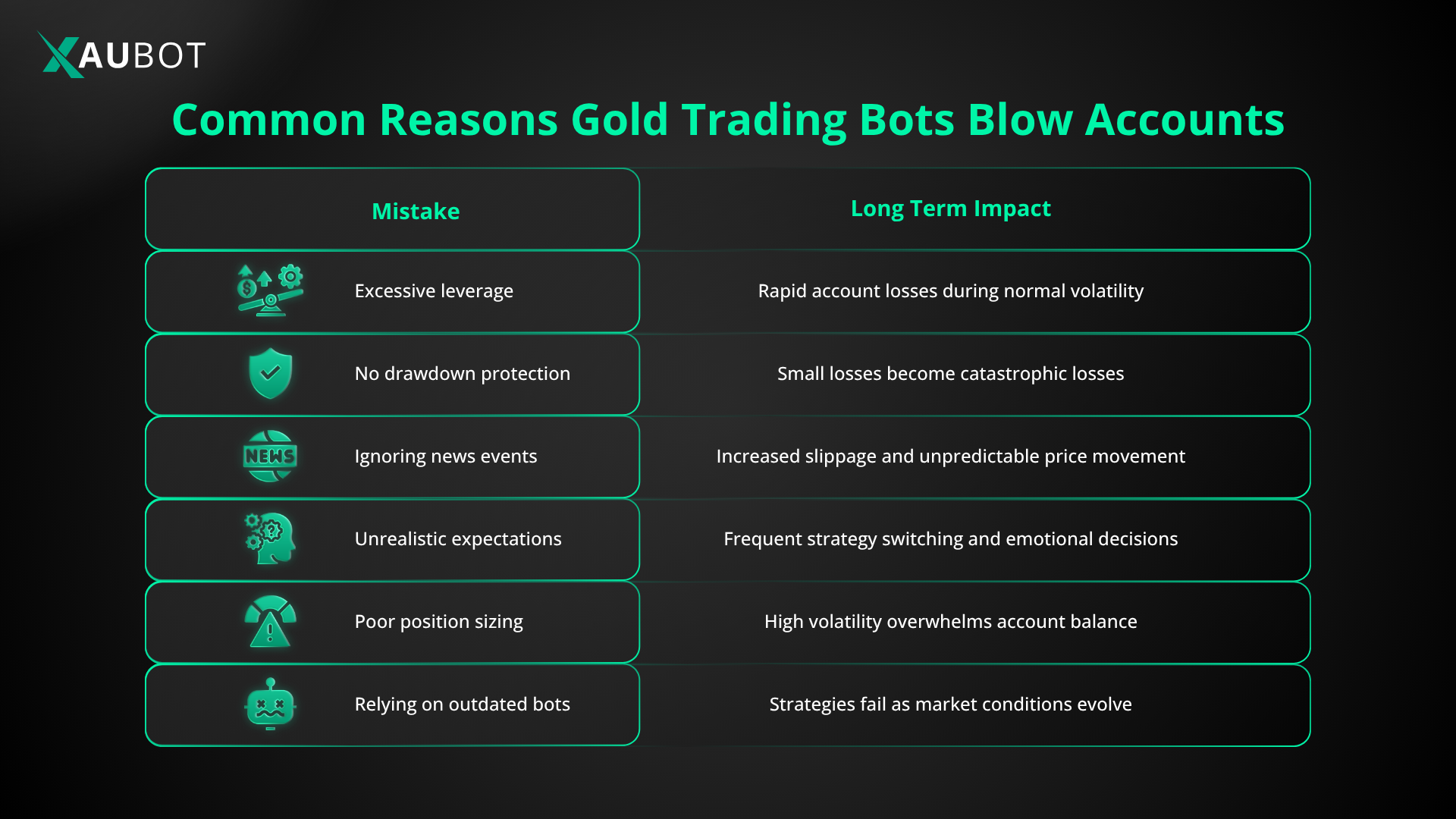
Most account failures are not caused by one catastrophic mistake.
They are caused by a series of small risk management errors that eventually combine into one large loss.
How XAUBOT Helps Traders Build Safer Gold Trading Systems
Gold trading has always been at the heart of XAUBOT.
Originally developed around XAUUSD, the platform has evolved into a complete AI powered automated trading solution that supports Forex, Metals, Crypto, Stocks, and Indices through MetaTrader 4 and MetaTrader 5.
Rather than encouraging aggressive configurations, XAUBOT gives traders extensive control over how their automated systems operate. Users can configure drawdown protection, trading hours, execution preferences, and overall risk management while benefiting from the AI Decision system, which incorporates technical market structure, live market conditions, sentiment analysis, and broader market interpretation before supporting trading decisions.
This combination of intelligent automation and configurable risk controls helps traders create systems designed for long term consistency rather than short term excitement.
Final Remark
A gold trading bot does not blow accounts because automation is flawed.
Accounts fail when traders underestimate risk, overestimate returns, or ignore the realities of one of the world’s most volatile financial markets.
A successful trading bot is not the one that generates the highest monthly return.
It is the one that can survive changing market conditions, control risk during periods of uncertainty, and continue operating consistently over the long run.
In gold trading, protecting capital is not a secondary objective.
It is the foundation on which every successful automated strategy is built.