Most traders spend their time searching for better entry signals.

Few spend enough time thinking about spreads.
That is a mistake, especially in gold trading.
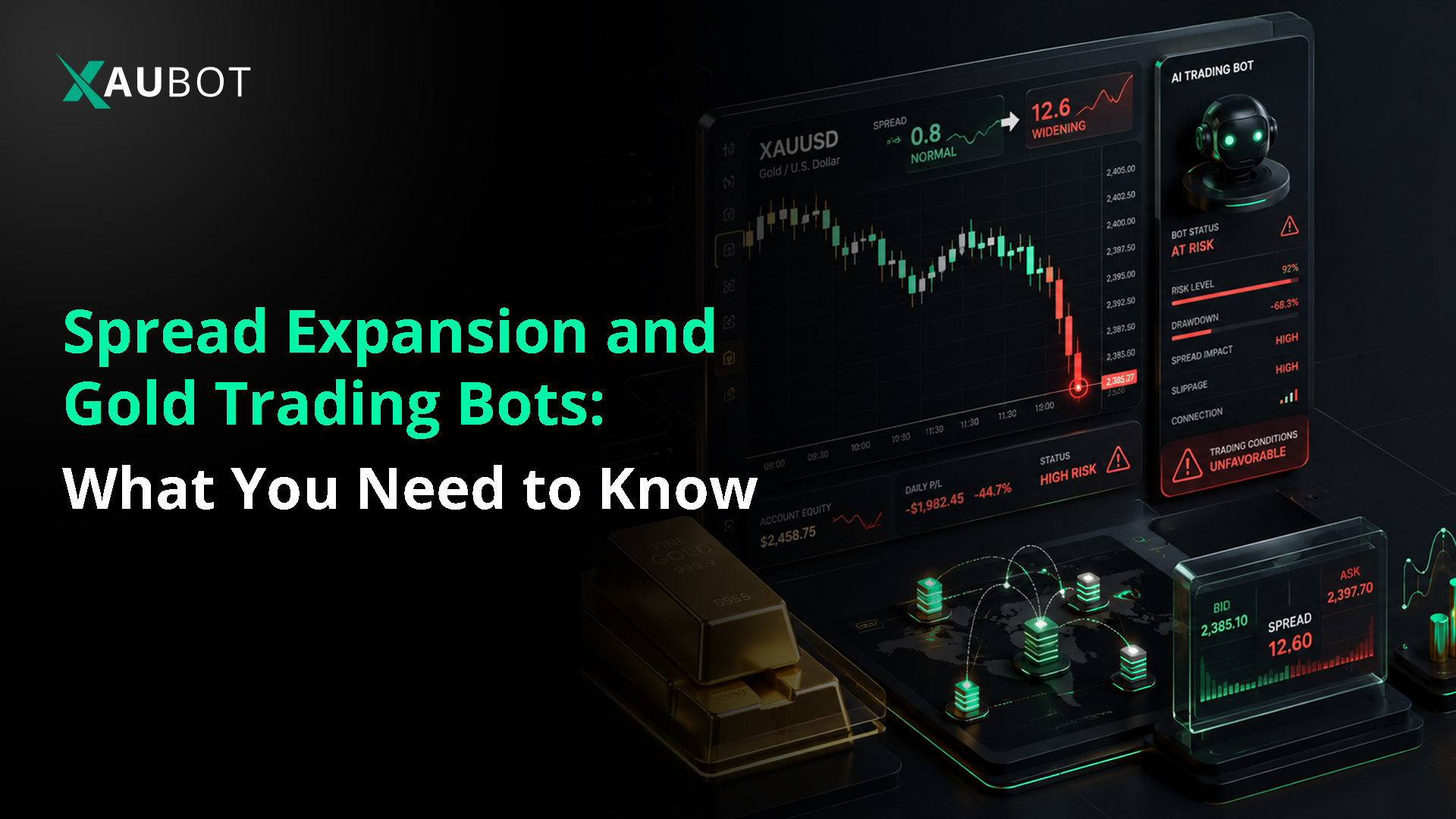
Spread expansion is one of the most overlooked reasons why a trading bot performs differently in live trading than it did during backtesting. Even a profitable strategy can struggle when trading costs suddenly increase, particularly in fast moving markets like XAUUSD.
Understanding how spreads behave is essential for anyone using a trading bot, ai trading bot, or ea trading bot on gold.
What Is Spread Expansion?
The spread is the difference between the bid price and the ask price.
Under normal market conditions, this difference remains relatively stable. During periods of high volatility or reduced liquidity, however, brokers often widen the spread to reflect increased market risk.
For traders, this means entering and exiting positions becomes more expensive.
For automated systems, it means every trade starts with a larger disadvantage.
A trading bot designed around normal spreads may suddenly find that profitable setups no longer produce positive results simply because transaction costs have increased.
Why Gold Is More Affected Than Many Markets
Gold is one of the most actively traded financial instruments in the world, but it is also one of the most volatile.
Its price reacts quickly to inflation reports, interest rate decisions, geopolitical developments, and changes in investor sentiment. During these events, liquidity can change dramatically and spreads often widen within seconds.
Unlike many major forex pairs, gold regularly experiences larger price swings over short periods, making execution quality much more important.
For this reason, spread management plays a far greater role in gold automation than many new traders realize.
When Spread Expansion Usually Happens
Although spreads can widen unexpectedly, several situations consistently produce larger trading costs.
| Market Condition | Typical Effect on Spreads |
|---|---|
| Major economic announcements | Significant widening during and immediately after the release |
| Market open after weekends | Temporary spread expansion while liquidity returns |
| Low liquidity trading hours | Wider spreads and reduced execution quality |
| Geopolitical events | Rapid spread increases during periods of uncertainty |
| High volatility sessions | Higher transaction costs across many brokers |
These conditions do not necessarily make trading impossible.
They simply require automated systems to recognize that market conditions have changed.
How Spread Expansion Affects Trading Bots
Many automated strategies assume relatively stable execution costs.
When spreads widen unexpectedly, several problems appear at the same time.
A stop loss may be triggered earlier than expected.
A take profit target may become harder to reach.
Scalping style strategies that depend on small price movements can lose much of their statistical advantage.
Over hundreds of trades, these seemingly small differences can significantly reduce profitability.
This is one reason why historical backtests frequently outperform live trading results.
Many historical datasets do not accurately reproduce changing spreads throughout different market conditions.

Smart Bots Account for Trading Costs
Professional automation does not simply search for good entries.
It also evaluates whether market conditions make those entries worthwhile.
Many experienced traders include spread filters within their automated systems. These filters prevent new trades whenever spreads exceed predefined limits.
Other traders reduce position sizes or avoid trading entirely during periods that historically produce unstable execution.
Rather than forcing trades into unfavorable conditions, the system waits until trading costs return to more normal levels.
Patience often becomes a competitive advantage.
Practical Ways to Reduce the Impact of Spread Expansion
Although spread expansion cannot be eliminated, traders can reduce its influence through better system design.
Some effective practices include:
- Trading during highly liquid market sessions
- Avoiding major economic announcements when appropriate
- Using brokers with consistently competitive spreads
- Monitoring execution quality over time
- Including maximum spread filters within the trading logic
- Testing strategies under realistic market conditions rather than ideal assumptions
Together, these adjustments help create more reliable long term performance.
How XAUBOT Helps Traders Manage Execution Quality
XAUBOT is designed to help traders build automated systems that consider real market conditions rather than idealized backtests.
Users can configure trading hours, execution preferences, risk management settings, and drawdown protection while creating a fully automated Expert Advisor for MetaTrader 4 or MetaTrader 5.
The platform’s AI Decision system strengthens decision making by combining technical market structure, live market conditions, sentiment analysis, and broader economic interpretation before supporting trade execution.
By allowing traders to build systems around changing market environments instead of fixed assumptions, XAUBOT helps reduce many of the practical challenges that affect live automated trading, including periods of increased volatility and changing execution conditions.
Comparing Normal and Expanded Spread Conditions
| Trading Environment | Normal Spreads | Expanded Spreads |
|---|---|---|
| Trade entry cost | Lower | Higher |
| Stop loss accuracy | More consistent | Greater chance of early activation |
| Scalping performance | Generally stronger | Often reduced |
| Slippage risk | Lower | Higher |
| Overall execution quality | More predictable | Less predictable |
Understanding these differences allows traders to evaluate their systems more realistically before risking live capital.
Final Remark
Spread expansion is not a flaw in the market.
It is a normal part of trading financial instruments like gold, particularly during periods of heightened uncertainty.
The best trading bots are not simply designed to identify opportunities.
They are designed to recognize when trading conditions have become too expensive or too unpredictable to justify opening new positions.
By treating execution quality as part of the trading strategy rather than an afterthought, traders can build more resilient automated systems and set expectations that better match real market behavior.