
When stocks enter correction territory, it means prices have fallen at least 10 percent from a recent high. It sounds dramatic, but in reality, this is one of the most normal phases in any financial market.

Corrections are not signs that something is broken. They are signs that the market is adjusting.
How Often Do Corrections Actually Happen?
One of the biggest misconceptions is that corrections are rare. They are not.
Historical data from major indices like the S&P 500 shows that:
- A drop of around 10 percent tends to happen roughly once every 12 to 18 months
- Some years see multiple corrections, especially during uncertain economic periods
- Many corrections recover within 3 to 4 months, although deeper ones can last longer
This matters because it reframes the idea completely. A correction is not an anomaly. It is part of the cycle.
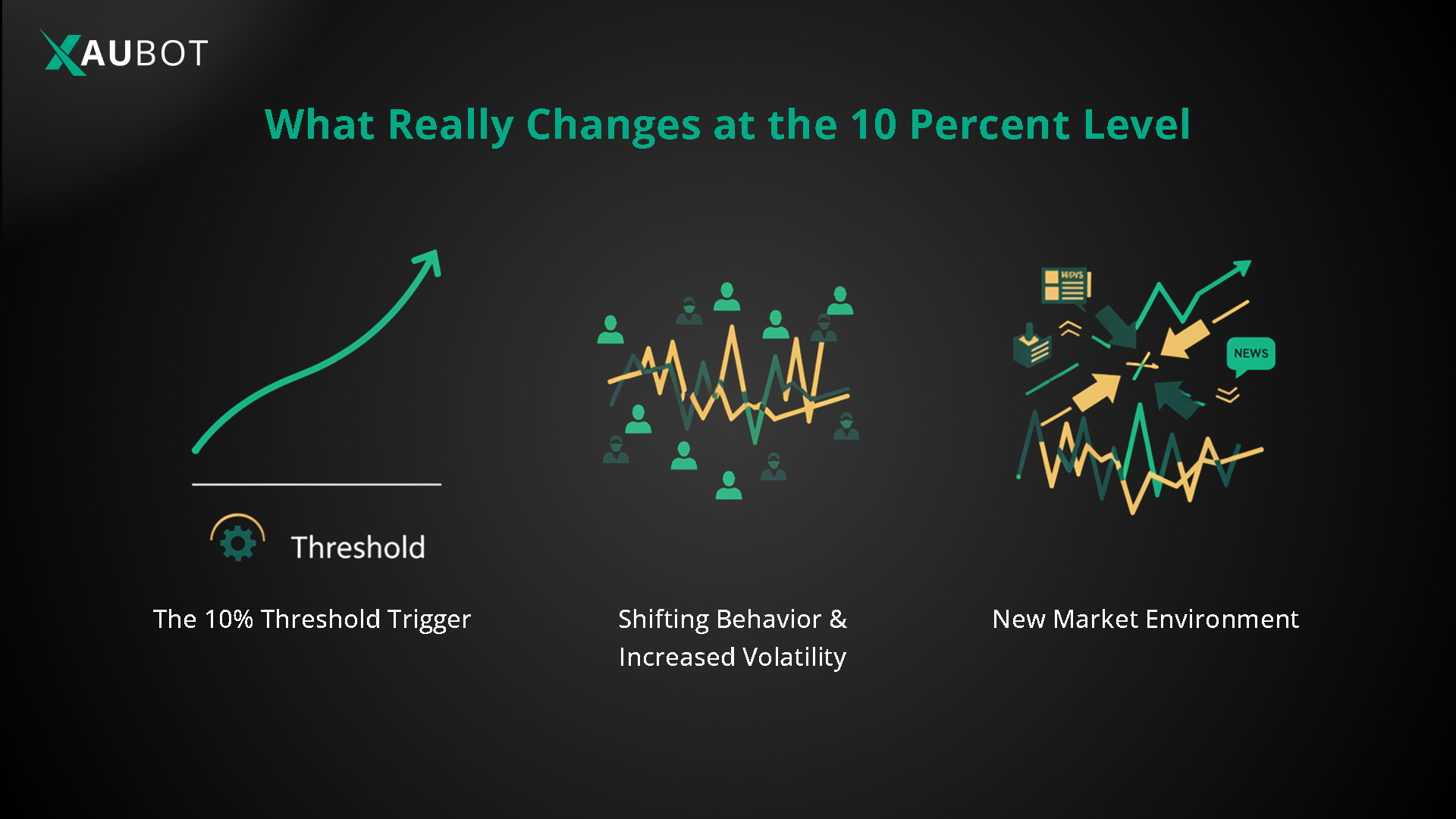
What Really Changes at the 10 Percent Level
The 10 percent threshold is important less because of the number itself and more because of what it triggers.
At this point, behavior starts to shift.
Investors who were comfortable during the uptrend begin to question whether the move is over. Short term traders become more defensive. Volatility tends to increase, and price action becomes less clean.
You start seeing things like:
- Trends breaking more frequently
- Strong moves in both directions instead of steady continuation
- Faster reactions to news and economic data
It becomes a different environment, not just a lower price.
Why Corrections Happen
There is usually no single cause. Corrections tend to build slowly and then appear suddenly.
Markets might have been rising too quickly. Valuations may have stretched beyond what earnings justify. Or external pressure builds until something triggers a shift.
Common drivers include interest rate changes, inflation surprises, weaker economic data, or geopolitical tension. But sometimes the cause is simpler. The market just needs to reset after moving too far, too fast.
Correction vs Something Worse
Not every drop leads to a crisis, and this is where many traders misread the situation.
A correction sits in a middle ground. It is more serious than a routine pullback, but it is not a full scale downturn.
- Around 10 to 20 percent decline is considered a correction
- Beyond 20 percent is generally labeled a bear market
The distinction matters because historically, many corrections do not turn into bear markets. They stabilize, consolidate, and eventually recover.
What This Means in Practice
During a correction, the market becomes less forgiving.
Setups that worked during a clean trend start failing. Moves that would normally continue begin to reverse. Confidence drops, and reactions become faster and less predictable.
For traders using a trading bot or ai trading bot, this is often where performance starts to change. Systems that rely on stable conditions or clear direction can struggle when the market becomes more erratic.
A forex trading bot or automated trading robot may still follow its logic perfectly, but the environment no longer supports that logic in the same way.
The Hidden Opportunity
Corrections are not only about risk. They also create opportunity, but only for those who understand what is happening.
Prices become more attractive for long term positions. Volatility creates movement that active traders can use. Weak positions get cleared out, which often sets the stage for the next phase of the market.
The key is not reacting emotionally. Many traders sell late into a correction or hesitate when conditions begin to stabilize.
A Better Way to Look at It
A correction is not a signal to panic. It is a signal to pay attention.
It tells you that the environment has changed. That alone is valuable information.
Whether you are trading manually or using a trading bot, recognizing correction territory helps you adjust expectations, manage risk more carefully, and avoid treating a shifting market as if nothing has changed.
Final Thought
Markets do not move in straight lines, and they are not supposed to.
Corrections are the mechanism that keeps them grounded. They remove excess, reset expectations, and create the conditions for the next move.
The traders who handle them best are not the ones who avoid them. They are the ones who understand what they are seeing and respond accordingly.