
“Set and forget” is one of the most attractive ideas in automated trading. Build a system, turn it on, and let it run without interference. No stress, no screen time, no second guessing.

In reality, that approach fails more often than it succeeds, and not because trading bots are flawed, but because markets are.
A trading bot does exactly what it is told to do. That is both its strength and its weakness.
The Problem Is Not the Bot, It Is the Environment
Markets today are not stable systems. They shift constantly due to macroeconomic changes, central bank policies, liquidity flows, and even unexpected geopolitical events. What worked in one phase can quietly lose effectiveness in another.
A forex trading bot that performs well during steady trends can struggle the moment the market turns sideways. A system that thrives in low volatility can start bleeding when volatility expands. These transitions are not rare events. They are the normal rhythm of the market.
The issue with “set and forget” is that it assumes stability where none exists.
Why Performance Fades Without Warning
Most traders expect failure to be obvious. They imagine a sudden drop or a clear breakdown. What actually happens is more subtle.
Performance erosion usually begins quietly. A few trades close at worse prices. A setup that used to work cleanly starts producing mixed results. The equity curve flattens before it falls.
This is where many automated trading robot users make their biggest mistake. They interpret slow degradation as temporary noise and leave the system untouched.
By the time the weakness becomes undeniable, the account has already absorbed the cost.
Backtests Create False Confidence
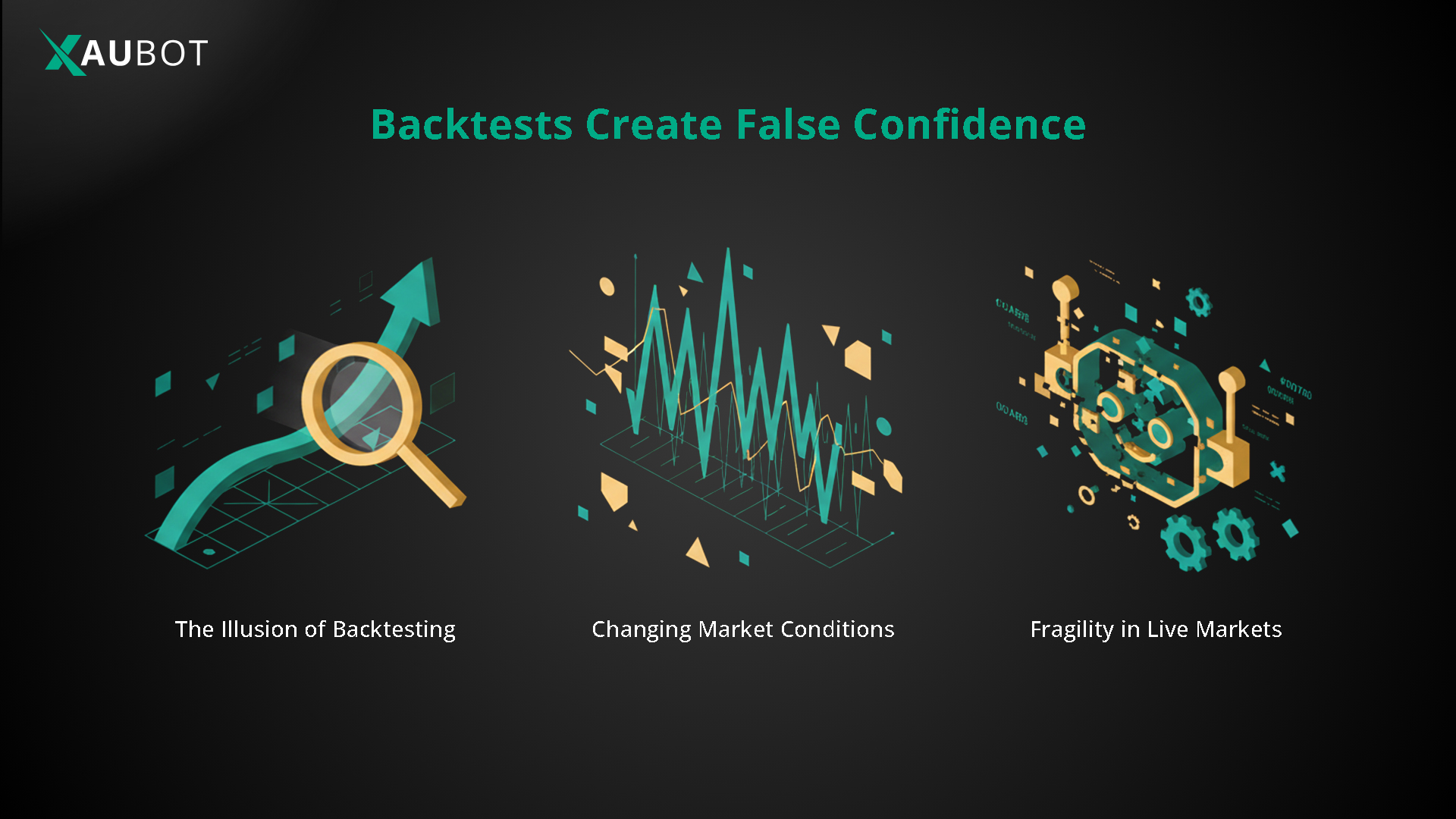
A major reason traders trust “set and forget” systems is the illusion created by backtesting. Historical results often look smooth, consistent, and reliable.
But those results are built on past conditions that no longer exist in the same way.
Even small changes in spread, execution speed, or volatility structure can break a system that was tightly tuned to historical data. This is especially true for many ea trading bot setups that rely on precise parameter optimization.
The more “perfect” a system looks in testing, the more fragile it often becomes in live markets.
Automation Does Not Mean Adaptation
There is a common belief that an ai trading bot can automatically adjust to changing conditions. In practice, most systems do not adapt in a meaningful way.
They may filter trades or adjust direction based on certain inputs, but their core logic remains fixed. They do not rebuild their strategy when the market environment changes.
So when conditions shift far enough, the system keeps applying rules that no longer fit.
That is not intelligence. That is repetition.
The Compounding Effect of Inaction
Leaving a bot unattended does not freeze performance. It allows small inefficiencies to accumulate.
A slightly worse entry here, a missed exit there, a few extra losses during unstable periods. None of these seem critical on their own. Together, they reshape the entire outcome.
This is why many traders feel surprised when they check their account after weeks or months. The decline feels sudden, but it was built gradually.
In trading, neglect is not neutral. It is an active risk.
What Experienced Traders Do Differently
Traders who succeed with automation rarely treat it as a passive system. They treat it as something that needs periodic alignment.
They watch how the system behaves, not just what it earns. They notice when trades start taking longer to resolve or when drawdowns stretch beyond their usual range. They adjust exposure when volatility increases and step back when conditions become unstable.
The bot still does the execution, but the trader remains responsible for the environment it operates in.
Where XauBot Fits Into This Reality
XauBot is built around the idea that automation should be controlled, not abandoned.
Instead of encouraging a “set and forget” mindset, it pushes users to define how their forex trading bot behaves under different conditions. Strategy type, risk level, drawdown limits, and trading hours are all part of the initial setup.
Features like news filters and AI decision support add another layer of awareness, helping the system avoid some of the most unstable moments in the market.
The result is not a hands off machine, but a structured system that is easier to monitor, adjust, and manage over time. Whether the output is an ea trading bot or a forex ea bot for MT4 or MT5, the responsibility stays where it should be.
A Better Way to Think About Automation
The real advantage of a trading bot is not that it replaces the trader. It is that it executes decisions consistently without emotion.
But consistency only works when the underlying logic still fits the market.
The traders who get the best results from trading bot and ai forex trading bot systems are the ones who stay engaged. They do not interfere constantly, but they do not disappear either.
They understand that automation is a tool for precision, not a shortcut to permanence.
Final Thought
“Set and forget” works in environments that do not change.
Markets are not one of them. And this is one of the many reasons why bots fail over time.
A trading bot will keep doing its job long after its edge is gone. The only question is how long it takes the trader to notice.