Choosing a trading bot is easy. Evaluating it correctly is where most traders fail.

Many users focus on surface level results like total profit or win rate, yet these numbers alone say very little about how a trading bot, ai trading bot, or ea trading bot will perform in real market conditions. The real edge comes from understanding the deeper metrics that reveal risk, consistency, and long term viability.
Why Basic Metrics Can Be Misleading
A trading bot showing high returns over a short period can still be fundamentally unstable. Some systems achieve impressive gains by taking excessive risk, using large position sizes, or relying on strategies that break under changing market conditions.
For instance:
- A bot with a 90 percent win rate might still lose money if its losses are significantly larger than its wins
- A system with strong monthly gains could be hiding dangerous drawdowns
This is why evaluating an automated trading robot requires looking beyond headline numbers.
Maximum Drawdown: The True Risk Indicator
Maximum drawdown measures the largest drop in account equity from peak to lowest point. It is one of the most important metrics for any forex trading bot.
A system that generates 50 percent annual return but suffers a 40 percent drawdown is far riskier than one producing 25 percent with only 10 percent drawdown.
Key insight:
- Lower drawdown means greater survivability
- High drawdown systems often fail before they recover
For most sustainable strategies, traders aim to keep drawdowns within manageable limits, typically below 20 percent.
Profit Factor: Measuring Efficiency
Profit factor compares total profit to total loss. It shows how much a system earns for every unit of risk taken.
- A profit factor above 1 means the system is profitable
- Above 1.5 is generally considered strong
- Above 2 indicates high efficiency, though it should always be validated in live conditions
A high profit factor in a trading bot or ai forex trading bot suggests that gains outweigh losses consistently, not just occasionally.
Risk to Reward Ratio
This metric evaluates how much a bot risks compared to its expected return per trade.
For example:
- Risking 1 percent to make 2 percent creates a favorable balance
- Risking 5 percent to make 1 percent creates long term instability
Many ea forex robot systems with high win rates still fail because their risk to reward structure is unbalanced.
Win Rate in Context
Win rate alone is one of the most misunderstood metrics in bot trading.
A high win rate does not guarantee success. What matters is how it works together with risk to reward and drawdown.
- High win rate with small profits and large losses can collapse quickly
- Lower win rate with strong risk control can be highly profitable over time
This is especially relevant in scalp strategies where frequent trades can create an illusion of consistency.
Trade Frequency and Market Exposure
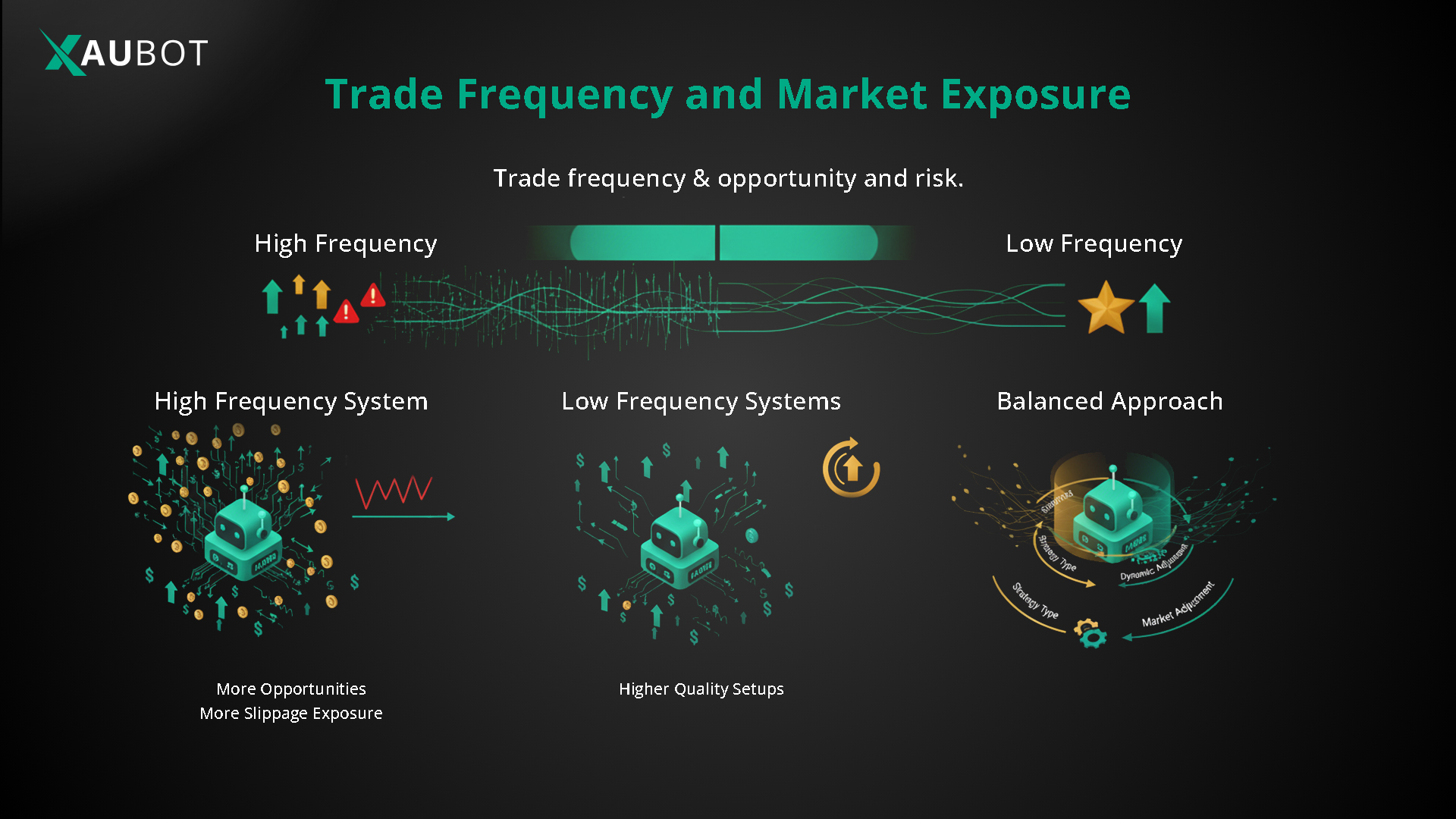
How often a bot trades affects both opportunity and risk.
High frequency systems:
- Capture more opportunities
- Are more exposed to execution issues like slippage
Low frequency systems:
- Trade less often
- Rely on higher quality setups
A balanced forex auto trading bot should align trade frequency with strategy type and market conditions.
Consistency Across Market Conditions
One of the most overlooked metrics is how a bot performs across different environments.
Markets shift between:
- Trending phases
- Ranging periods
- High volatility events
A robust trading bot maintains stable performance across these conditions, rather than excelling only in one specific scenario.
Recovery Factor and Stability
Recovery factor measures how quickly a system recovers from drawdowns. It is calculated by comparing total profit to maximum drawdown.
A strong system:
- Recovers losses efficiently
- Maintains upward equity growth over time
This metric is critical when evaluating long term viability of an automated trading robot.
Execution Sensitivity
Even the best metrics can break down if execution is poor.
Latency and slippage can significantly impact:
- Entry and exit accuracy
- Real profit levels
- Overall system reliability
A trading bot that performs well in testing but fails under real execution conditions is not truly robust.
How XauBot Helps You Focus on What Matters
XauBot is designed to guide users toward building trading bots with these key metrics in mind from the start.
When creating a forex trading bot, users define:
- Risk level and capital allocation
- Drawdown limits to protect the account
- Strategy type, including multi level or scalp approaches
- Entry logic ranging from reversal based systems to trend following models
Additional features such as news filters and optional AI decision support help reduce exposure during unstable conditions and align trades with broader market sentiment.
This structured process encourages traders to focus on real performance metrics rather than misleading surface level results. The final ea trading bot or forex ea bot can then be exported for MT4 or MT5, ready for live trading with built in risk awareness.
Evaluating Bots Like a Professional
The difference between profitable traders and frustrated users often comes down to how they evaluate systems.
Instead of chasing high returns, focus on:
- Controlled drawdowns
- Consistent performance
- Balanced risk to reward
- Realistic execution conditions
A well evaluated trading bot, ai trading bot, or ea trading bot becomes a reliable tool rather than a risky gamble.
In the long run, understanding these metrics is what separates short term gains from sustainable automated trading success.