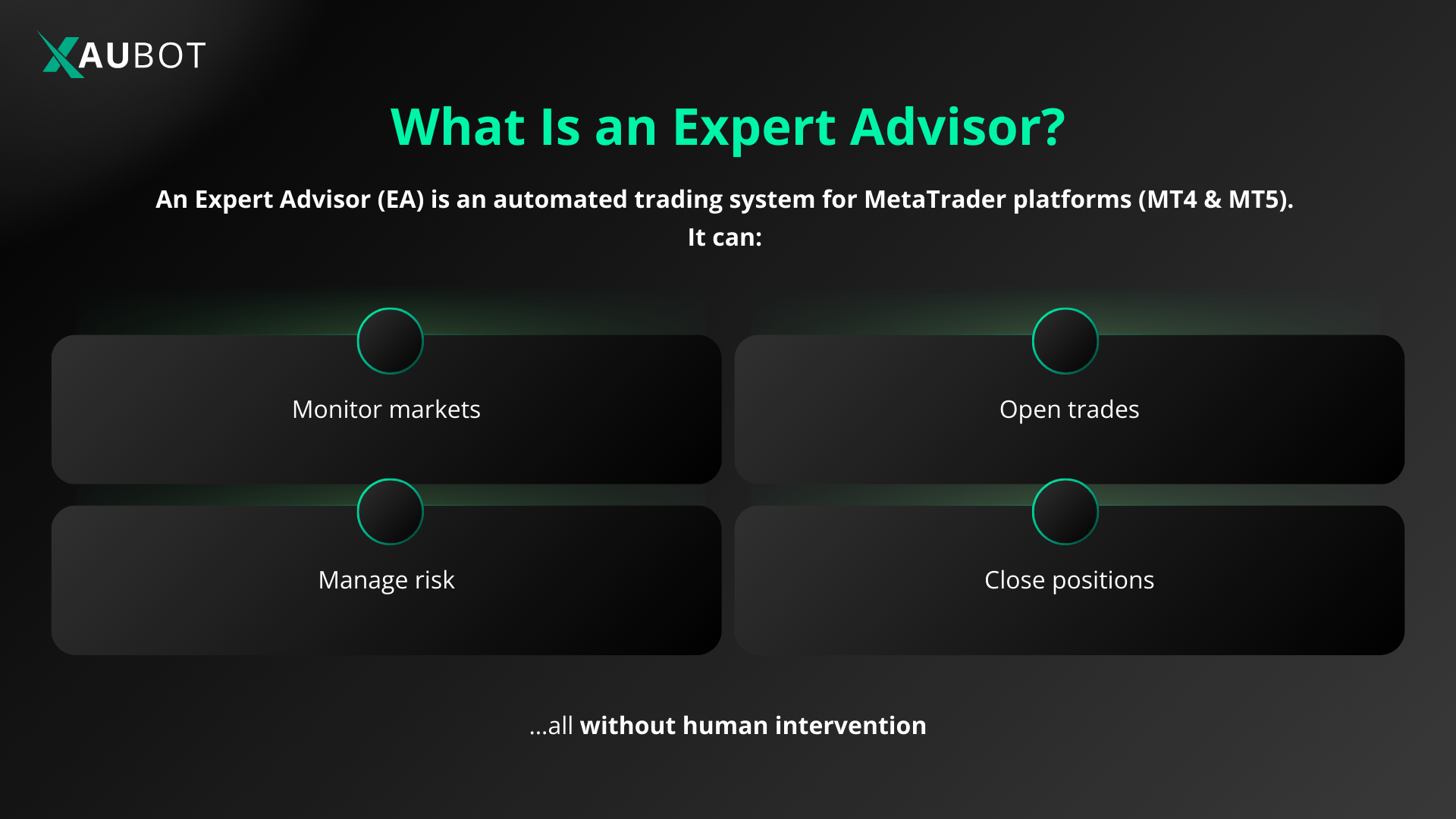
An expert advisor, which is also known as an EA, is simply an automated trading tool, an algorithm, a software, or simply put, a bot designed for the trading platforms MetaTrader 4 (MT4) and MetaTrader 5 (MT5).

And as you know, a trading bot will help traders to transform a trading strategy into an automated program that will run on their trading platform, monitor the market, and execute trades for them without the need for the trader’s intervention.
Countless traders around the world rely on expert advisors to execute their trades in order to achieve sustainable results in the market.
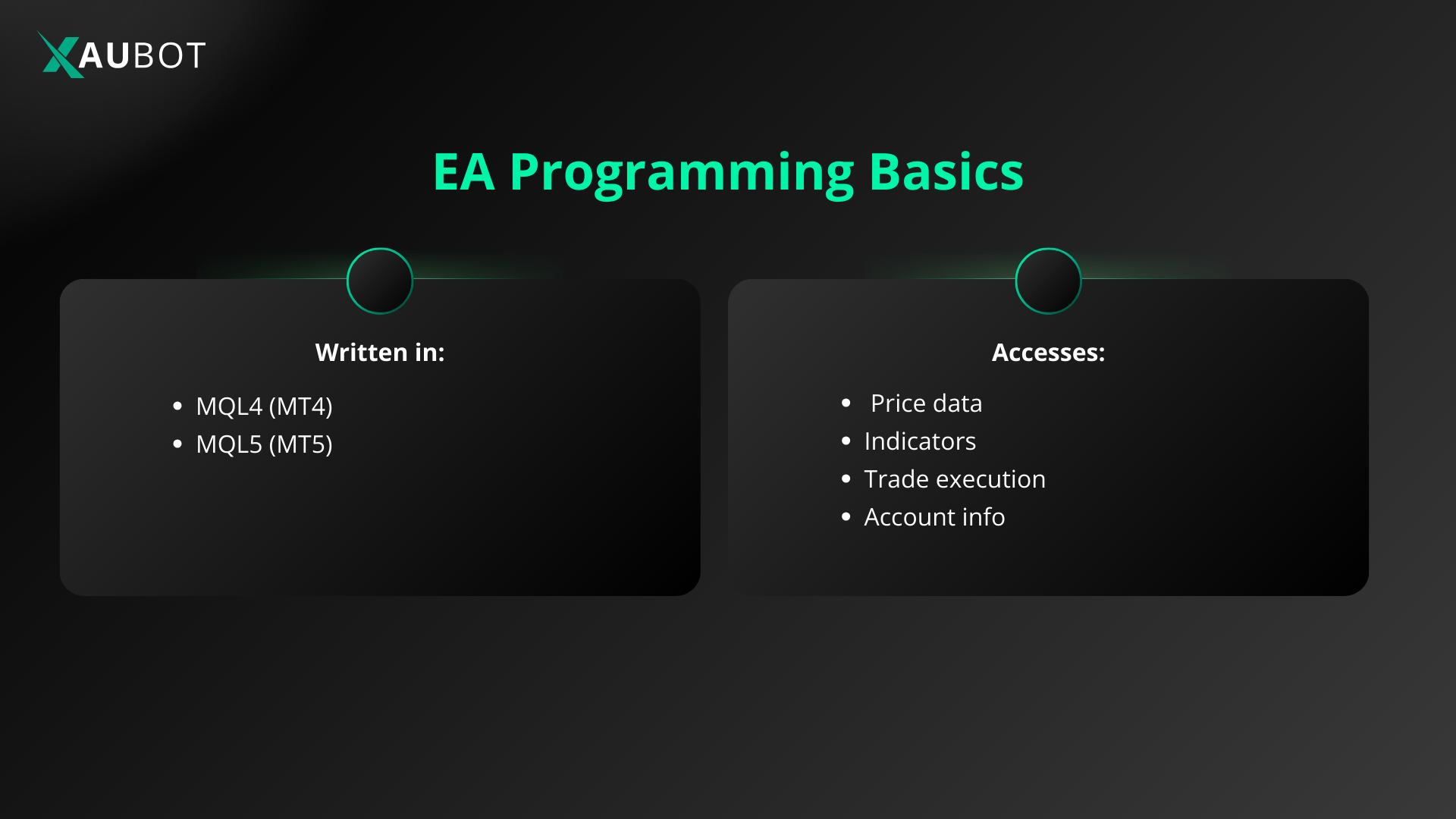
And all of this is possible just through the use of an expert advisor. An EA is basically just like any other software that is coded with the help of a programming language. The language that is used in the development of an expert advisor is MetaQuotes Language (MQL4 for MT4 or MQL5 for MT5). This programming language is the proprietary language for the MetaTrader platform.
So, when an EA is developed and installed on the trading platform it will allow for the full automation of trading on MetaTrader.
The Internal Workflow of an Expert Advisor
The way expert advisors work is logical in that they operate fully based on a cycle of events. These cycle of events are the changes that occur in the market and the EA will react to them accordingly. It is like having a scenario ready for the various changes that occur in the market.
But what exactly are these so-called events?
The most important event is OnTick(), which triggers every time a new price tick arrives. In this function, the EA collects current market data such as bid/ask prices, spread, and volume. It then calculates any required indicators (moving averages, RSI, MACD, Bollinger Bands, Stochastic, ATR, and many others) using built-in MQL functions.
Next comes the decision-making phase. The EA evaluates a series of conditions defined in the code. For instance, a simple trend-following EA might check if a fast EMA has crossed above a slow EMA while RSI remains below overbought levels. More advanced EAs incorporate multi-timeframe analysis, price action patterns, support/resistance zones, or even volatility filters using ATR.
When all entry conditions align, the EA moves to execution. It uses functions like OrderSend() in MQL4 or CTrade class methods in MQL5 to place market or pending orders. It simultaneously sets stop loss, take profit, and sometimes trailing stop parameters. Lot size calculation often follows money management rules, such as risking a fixed percentage of equity or using volatility-based positioning.
Throughout the trade lifecycle, the EA monitors open positions via OnTrade() or periodic checks. It can modify orders, move stop losses to breakeven, implement partial closes, or trail profits based on predefined rules. When exit conditions trigger (take profit hit, opposite signal, time-based closure, or protective drawdown limit), the EA closes positions automatically.
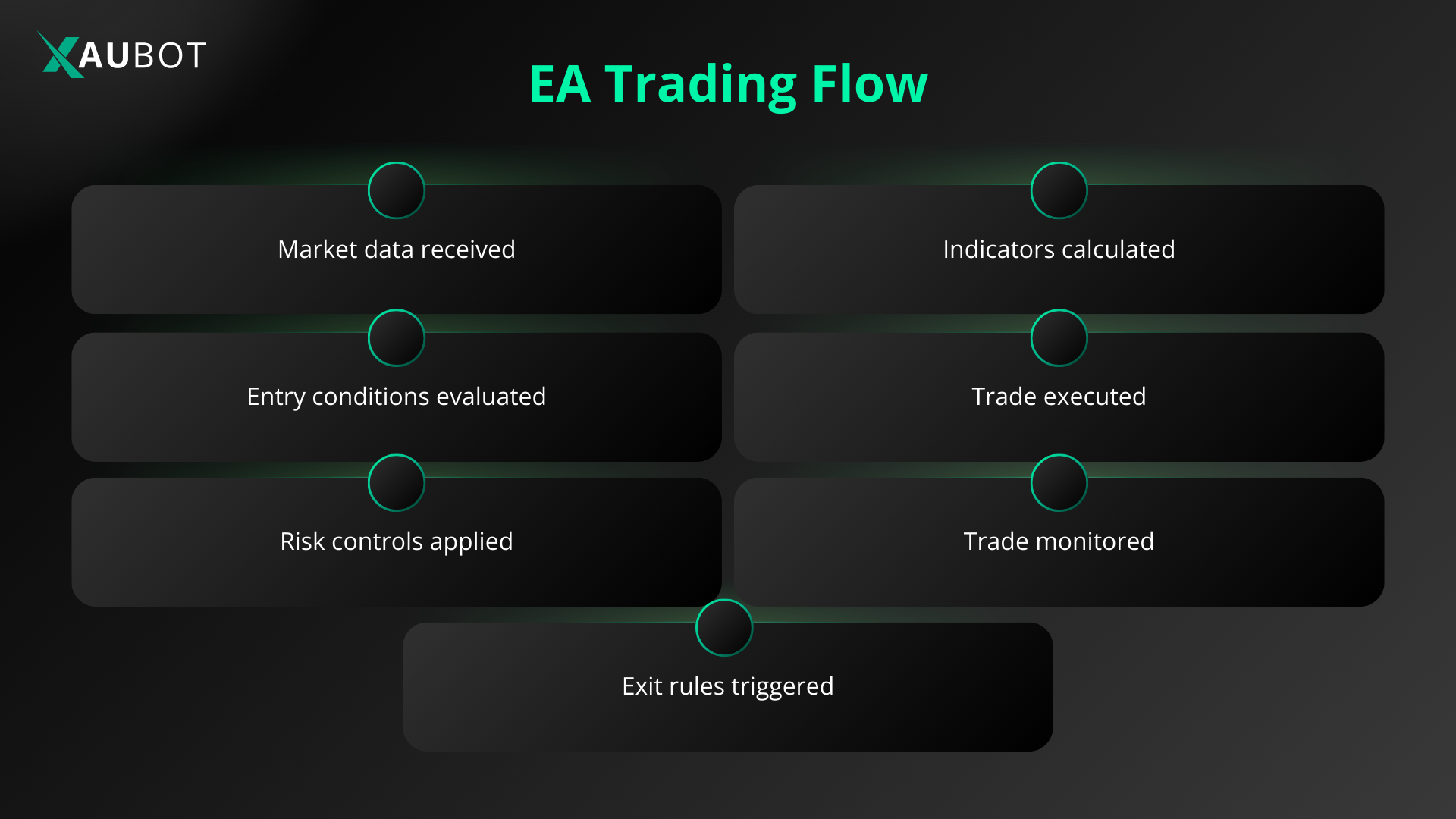
To illustrate the flow more clearly, here is the typical sequence:
- Market Data Collection The EA gathers real-time information on every new tick, including prices, spreads, volume, and freshly calculated indicator values to ensure decisions are based on the latest market state.
- Decision-Making Phase It systematically checks the coded logic, combining simple or complex conditions (crossovers, oscillator levels, multi-timeframe alignment, or pattern recognition) to generate reliable buy, sell, or no-trade signals.
- Trade Execution Once a signal is confirmed, the EA immediately places orders with precise parameters, applying calculated lot sizes and attaching initial risk controls like stop loss and take profit.
- Ongoing Trade Management The EA continuously supervises open positions, making adjustments such as trailing stops, breakeven moves, partial profit-taking, or full closures when predefined exit rules are met.
Advanced Technical Features Found in Modern EAs
The new Expert Advisors often include sophisticated components to improve reliability and performance.
Money management modules dynamically adjust lot sizes according to account balance, equity, margin levels, or ATR-based risk models. Many implement position sizing formulas like fixed fractional risk (1 percent per trade) or optimal f calculations.
Time and session filters restrict trading to specific hours, such as London or New York sessions, to avoid low-liquidity periods or high-spread times.
News filters can pause trading around major economic releases by reading an economic calendar via web requests or internal lists.
Martingale, grid, or multi-level averaging logic appears in some EAs, where additional positions open at predefined intervals against the initial direction, aiming to recover when price reverses.
Trailing stop mechanisms include fixed pips, ATR multiples, or moving average trails to lock in gains during strong trends.
Error handling routines manage common issues like requotes, off-quotes, slippage, or connection loss by retrying orders or alerting the trader.
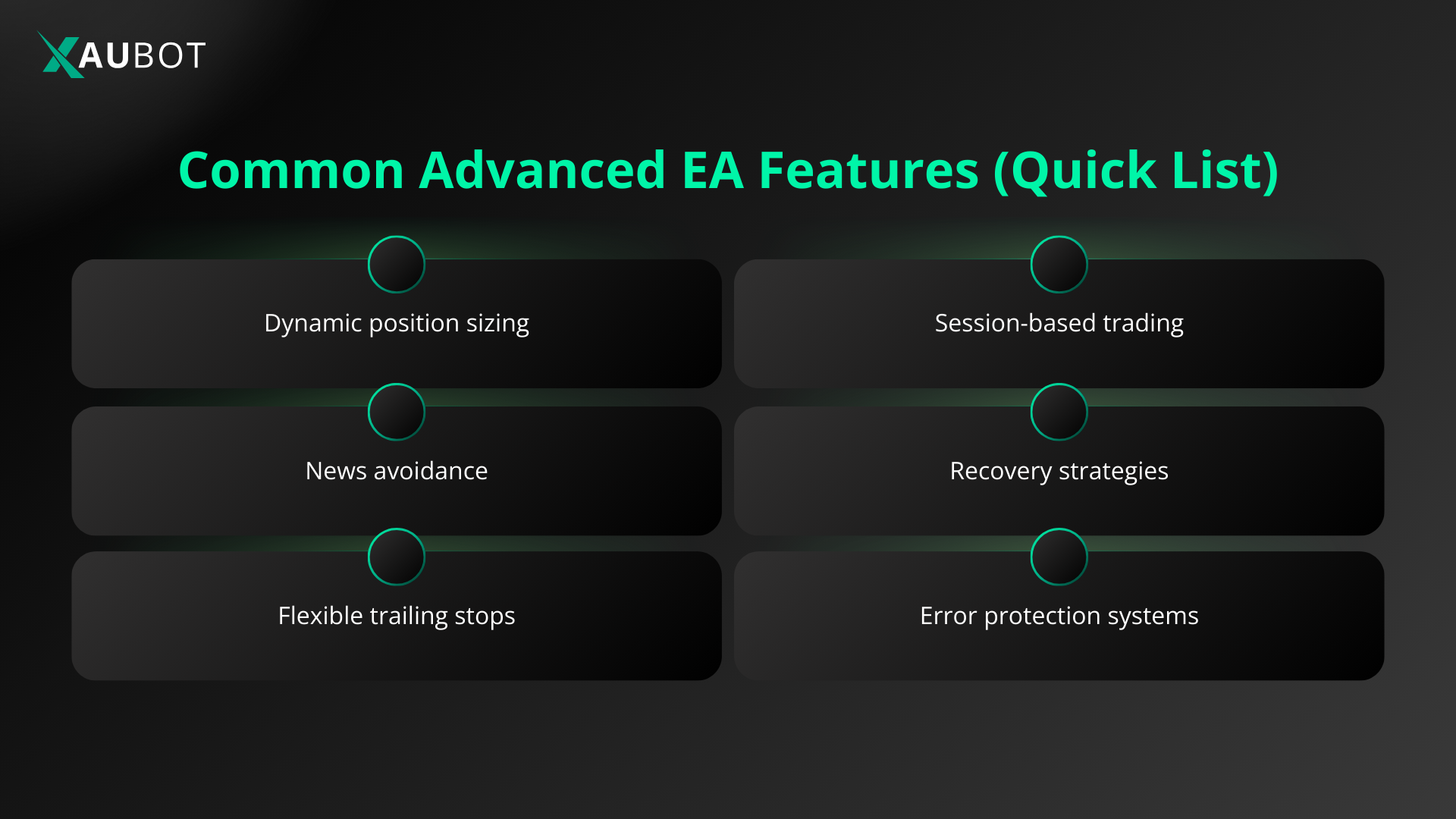
Here are some common advanced features at a glance:
- Dynamic lot sizing based on risk models
- Session-specific trading restrictions
- Built-in news avoidance mechanisms
- Recovery strategies like averaging
- Flexible trailing stop options
- Robust error recovery protocols
Why Traders Choose Expert Advisors
EAs eliminate emotional decisions such as fear of pulling the trigger or holding losing trades too long. They execute strategies exactly as coded, ensuring consistency across hundreds of trades. They operate 24/5 without breaks, capturing opportunities across multiple currency pairs, indices, metals, or cryptocurrencies simultaneously.
Backtesting and optimization tools in MetaTrader allow traders to evaluate EA performance on years of historical data, refining parameters for better results. Forward testing on demo accounts further validates live behavior before committing real capital.
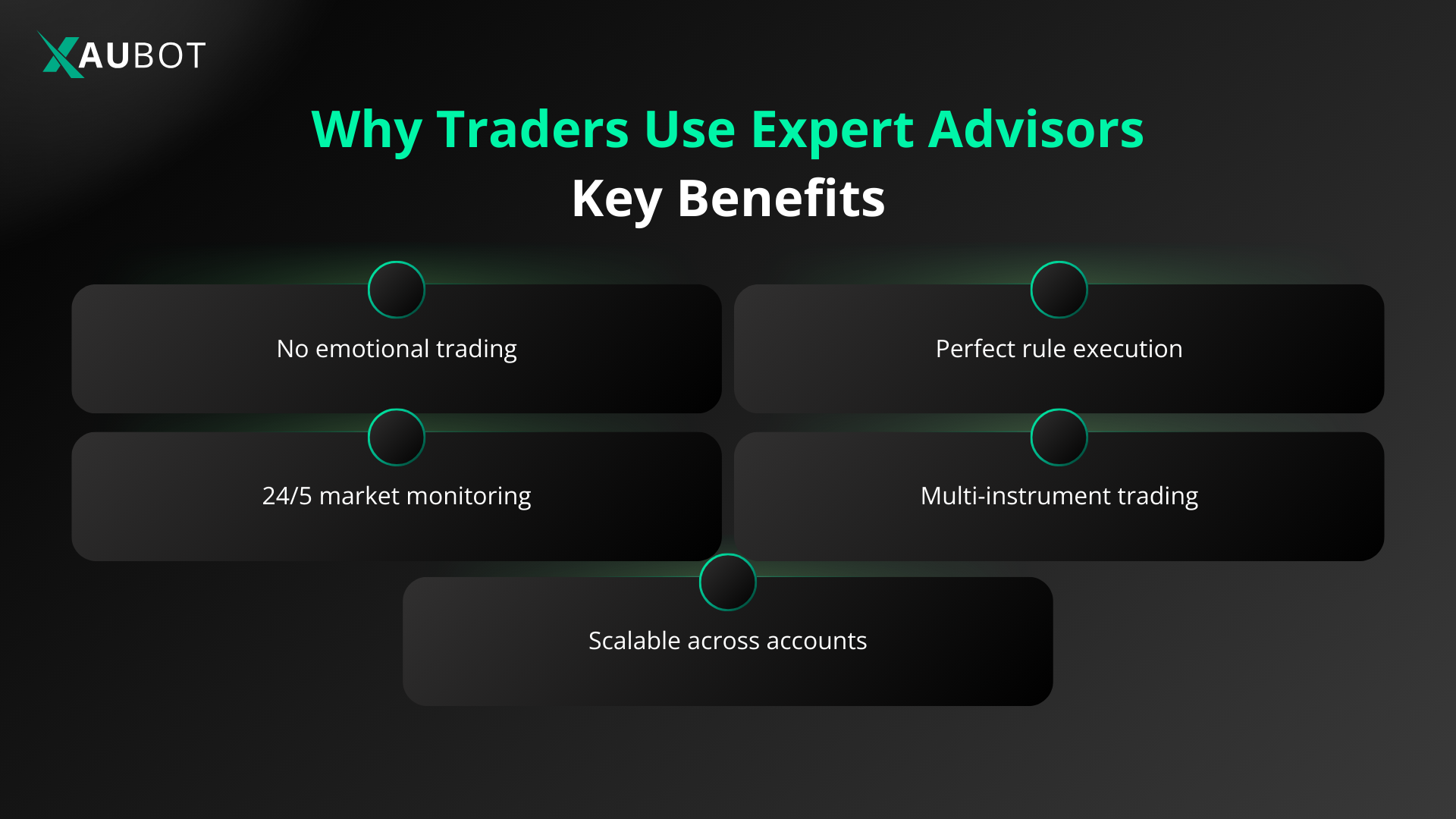
Key advantages include:
- Complete removal of emotional bias
- Perfect rule adherence and discipline
- Round-the-clock market coverage
- Ability to handle multiple instruments
- Comprehensive testing capabilities
Important Considerations and Risks
While powerful, EAs carry risks. Over-optimized settings may perform brilliantly in backtests but fail in live markets due to curve fitting. Changing market conditions (trending versus ranging) can render a once-profitable strategy ineffective. Poorly coded money management can lead to rapid account drawdowns, especially in averaging or martingale systems.
Brokers sometimes restrict certain EA behaviors, such as high-frequency scalping or excessive order modifications. Latency and slippage also affect performance, particularly for strategies relying on precise entries.
Successful EA trading requires ongoing monitoring, periodic re-optimization, and robust risk controls. Common pitfalls to watch for:
- Curve fitting from excessive optimization
- Failure to adapt to new market regimes
- Aggressive risk leading to blowouts
- Broker-imposed limitations
- Real-world execution discrepancies
How XauBot Fits into EA Trading
Although we learned fundamental and significant aspects of developing an expert advisor with the help of the MQL language, there are still other ways that can make things simpler for you.
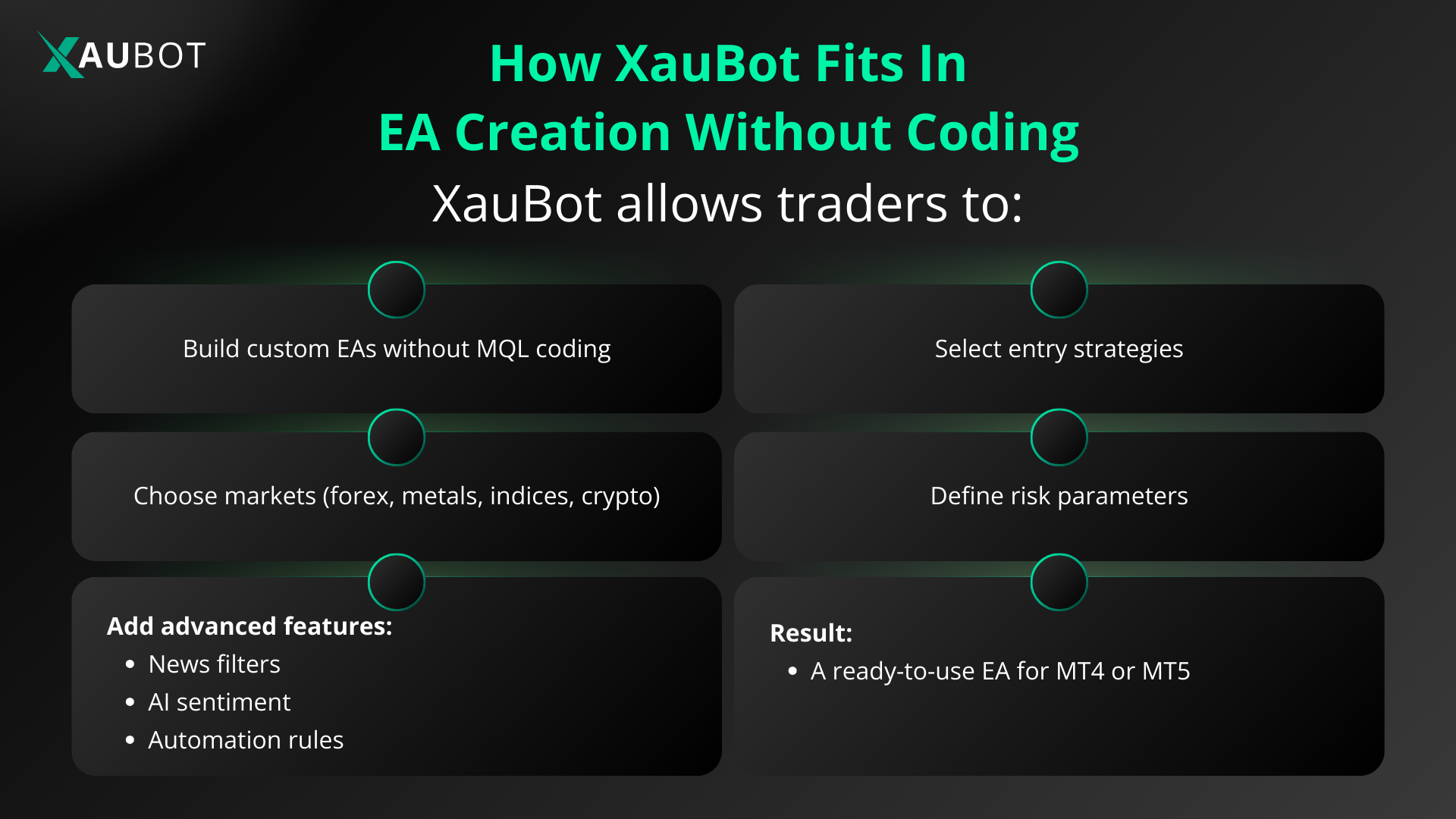
For traders who want a professional-grade EA without learning MQL programming, platforms like XauBot provide a user-friendly solution. XauBot allows anyone to configure and generate custom Expert Advisors for MT4 and MT5 in an easy to follow step by step process.
In this process, users select markets (forex, metals, indices, or crypto), choose proven entry strategies, define risk parameters, and add optional features like news filters or AI sentiment analysis. The platform then builds and exports a ready EA tailored to those specifications, making advanced automation accessible to traders of all experience levels.
Conclusion
Expert Advisors transform trading strategies into precise, emotion-free systems that operate tirelessly within MetaTrader environments. By understanding their internal logic, technical components, and limitations, traders can harness automation effectively while maintaining proper oversight.
Whether coding your own EA or using a generation platform like XauBot to create one, the key remains the same: a solid underlying strategy combined with disciplined risk management forms the foundation of long-term success in automated trading.