
The foreign exchange market is the ultimate financial venue in the world. In this market, not only millions but actually billions of dollars are moving from hand to hand on a daily basis at every moment.
In this billion-dollar movement is the rich possibility for profitability. But at the same time, there are also dangers of losing your money at every turn.
This is why, regardless of whether you are a beginner or a highly experienced trader, you ought to follow certain rules and guidelines which are designed specially to ensure your success and prolonged profitability in this market.
While there are many such rules that you need to know and stick to, in this article we are going to focus on particular and general rules that every trader needs to know – the 1 and 90 rules.
What is Forex Trading?
What is forex trading? Forex trading, also known as foreign exchange or FX trading, involves buying one currency while simultaneously selling another in hopes of profiting from changes in their exchange rates. The forex market is the largest and most liquid financial market globally, with trillions of dollars traded daily.
In forex trading, currencies are always paired, such as EUR/USD, where you speculate on whether one currency will strengthen or weaken against the other. This differs from stock trading because forex operates 24/5 across global sessions, driven by economic data, geopolitical events, and central bank policies.
Many beginners ask what is forex? Simply put, it’s the decentralized marketplace for exchanging currencies. Understanding the question what is forex trading is the foundation before applying rules like the 1% risk guideline.
Forex Trading for Beginners
Forex trading for beginners starts with education and discipline. New traders often jump in without a plan, leading to quick losses, you can look at the cautionary side of the 90% rule.
Key steps for forex trading for beginners:
- Learn basics: Understand currency pairs, pips, leverage, and spreads.
- Practice on demo accounts to test strategies without real risk.
- Build a trading plan with clear entry and exit rules and the 1% rule to limit losses.
- Focus on major pairs for better liquidity and lower spreads.
Trading forex requires patience. Start small, track every trade in a journal, and prioritize capital preservation over quick wins.
What is the 1% Rule?
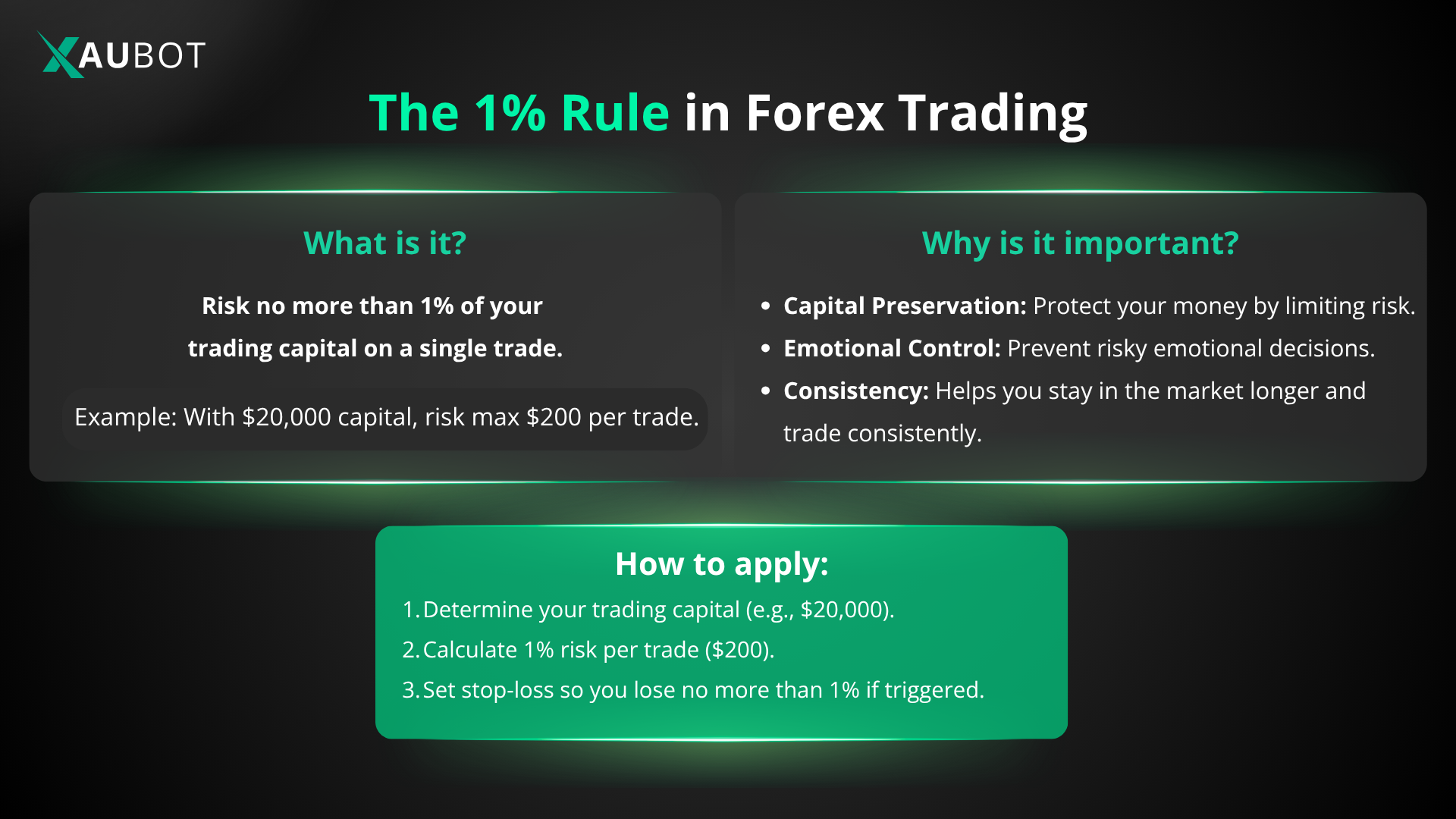
The 1% rule is a risk management rule and guideline which is like the most important tip that literally all forex traders need to know. It is based on the fact that you should not risk more than 1% of your capital on a single trade.
So for example, if your trading account is $20,000, the maximum that you should risk per trade should not exceed $200. In other words, you should not be willing to lose more than $200 per trade with the mentioned account balance.
Obviously, the amount or percentage that you would risk per trade depends on so many factors and can vary substantially given your trading strategy and how aggressive you want to trade.
The 1% rule is more like a symbol of how much you should be risking per trade.
To understand it better, you can think of it as the amount of money that you are willing to lose per trade. The worst case scenario. Imagine you stand to lose that money per trade. So perhaps now you understand where the 1% rule comes from.
Why is the 1% Rule Important?
- Capital preservation: first and foremost, it is a rule that helps you preserve and protect your capital by not risking more than you should.
- Emotional control: at the same time when the size of positions is controlled through this role, it also helps to prevent emotional decision making through risking too much.
- Consistency: by managing risks and capital allocation, this rule will help you remain in the market for longer and aim to achieve consistent results.
Understanding the 1 and 90 rules in Forex Trading
How to Apply the 1% Rule?
- Determine your trading capital: For example, $20,000.
- Calculate your risk per trade: 1% of $20,000 = $200.
- Set your stop-loss accordingly: your stop-loss should be set such that if triggered, you lose no more than 1% of your account balance, which in this case is $200.
What is the 90% Rule?
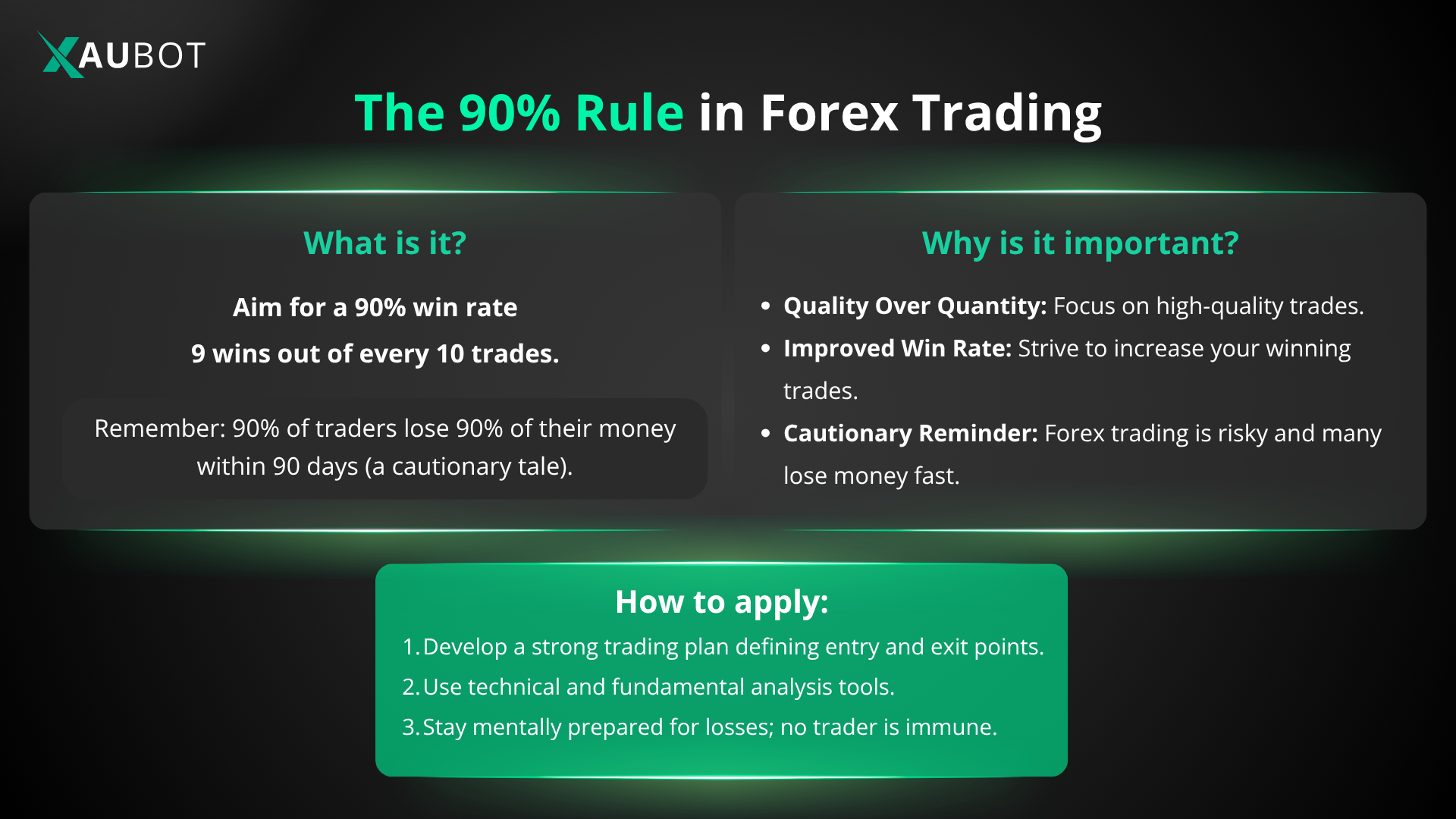
The 90% rule is more like a psychological and cautionary tale among traders. This rule, in fact, refers to two extremely important phenomena in this market.
First of all, it refers to the fact that you must always aim for the 90% rule itself – meaning that you must always strive to get a 90%-win rate for your trades, which is equivalent to 9 wins out of every 10 trades that you execute.
Of course this is a really high win rate. But you must always aim high.
But there is also another interesting belief among traders that has formed the 90% rule in forex. The belief goes that 90% of traders lose 90% of their money within 90 days of trading in the forex market.
While that may not be literally true and more of a cautionary tale, it is still highly valuable. It simply refers to just how dangerous and risky it can be to trade without proper cautions in the forex market.
So, the 90% rule leads you to aim high in the forex market while at the same time remember that the possibility of loss is just as high as any other possibility.
Why is the 90% Rule Important?
- Quality over quantity: the rule emphasizes high quality trades over simply going for high quantity of trades.
- Improved win rate: the 90% rule is first and foremost the highest attention on improving your win rate as a trader.
- Caution: the bit about 90% of traders losing 90% of their money is the most symbolic way of indicating just how easy it is for traders to lose their money in this market and acts as a powerful cautionary reminder for all traders no matter how professional.
How to Apply the 90% Rule?
- Develop a strong trading plan: in order to aim for a high win rate while at the same time sticking to strong and reliable risk management, you need to develop a strong trading plan that defines various aspects of trading for you, including entry and exit.
- Use technical analysis tools: rely on technical analysis tools and indicators for increased accuracy, reliability, and safety for your decisions as a trader.
- Incorporate fundamental analysis: no matter how experienced or pro you are, never neglect the impact of fundamental factors on the forex market.
- Always ready for loss: you must have a winning mindset, but at the same you need to know that nobody knows what is going to happen in the financial market. So remember that nobody and no trader is immune from loss in the forex market.
Is Forex Trading Profitable?
Is forex trading profitable? Yes, it can be for disciplined traders who follow sound risk management and strategies. However, profitability isn’t guaranteed. Most retail traders face challenges, aligning with the 90% rule’s warning about high loss rates.
Success in forex trading comes from:
- Consistent application of rules like risking no more than 1% per trade.
- Realistic expectations: Aim for steady growth (for example 1-5% monthly) rather than get-rich-quick.
- Combining technical and fundamental analysis with emotional control.
Is forex trading profitable long-term? Only if you treat it as a skill-based endeavor, not speculation. Many who survive the initial 90 days and refine their approach see positive results over time.
Is Forex Trading Gambling?
Is forex trading gambling? This is a common question, and the answer depends on your approach. If you trade without a plan, chase losses emotionally, or rely purely on luck, then yes forex trading can resemble gambling.
However, proper forex trading is nothing like gambling.
- Gambling has a built-in house edge with negative expected value.
- Skilled forex trading uses analysis, risk management (like the 1% rule), and tested strategies to tilt odds in your favor over many trades.
- The 90% rule reminds us that poor discipline leads to losses, but structured trading emphasizes probability and edge.
Avoid treating forex trading like gambling. Stick to rules, preserve capital, and focus on high quality setups for better outcomes.
Additional Forex Trading Rules and Tips
There are so many different rules and guidelines that can help you always stay above water in trading and avoid drowning in the volatilities. We discussed the ever famous 1% and the 90% rules among traders in the forex market. But here are also a couple more rules that can help you even further:
- Never trade without a plan: you must always have a clear plan that defines your entry, your exit, and the parameters for risk management.
- Avoid emotional trading: do not get emotional as a trader. Discipline and composure are key to success as a pro trader.
- Use leverage cautiously: leverage can be the difference between a 90%-win rate or losing 90% of your capital!
Make sure to always use leverage cautiously. Do not go for high rates if you do not have enough experience using leverage.
- Diversify trades: diversity is always a key to success in all financial markets including the forex market. Do not put it all on one pair. Split it out among several trading pairs.
Conclusion
As much opportunity there is in the forex market, there are also risks at every turn. With the billions of dollars being trades, some are making millions and some are losing millions. If you do not want to be among those losing millions, then you need to have rules and guidelines as a forex trader.
In this article we discussed two of the most popular and well-known rules among traders in this market – i.e. the 1% rule which refers to no risking more than 1% per trade and the 90% rule which is more of a caution about increasing your win rate and always remembering that it is possible to lose almost everything.